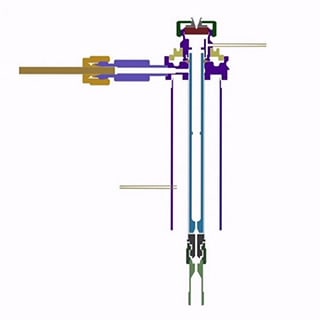
Multimode Inlet (MMI) for GC
Multimode Inlet
The injection technique that is used for a method can be tailored to the compounds in your samples. Using the MMI, the gas chromatograph can meet current analytical needs and provide flexibility to meet future requirements.
- GC Inlets
Product Details
- Large volume injection (LVI) capabilities
- Agilent Turn Top inlet for easier maintenance
- Temperature range of -160 ºC to 450 ºC
- Agilent Solvent Elimination Calculator assists user in setting large-volume injection parameters
- Cooling options include air, liquid nitrogen, and liquid carbon dioxide
- Electronic septum purge flow control to eliminate ghost peaks
- Compatible with Merlin Microseal for GC
- Injection modes include split, pulsed split, splitless, pulsed splitless, solvent vent, direct, and sleep
- Split mode is generally used for major component analysis
- Pulsed split mode is like split mode, but with a pressure pulse applied to the inlet during sample introduction to speed the transfer of material to the column
- Splitless mode is used for trace analysis
- Pulsed splitless mode allows for a pressure pulse during sample introduction
- Solvent vent mode is used for large-volume injection; single or multiple injections can be made for each run
- Direct mode allows for a direct forward pressure of carrier gas through the column with the split vent closed
- Sleep mode is used for creating sleep methods, or if all gas needs to flow onto the column
- Application Notes
-
Volatile PFAS in Cosmetics Using PAL3 Coupled with Triple Quadrupole GC/MS
This application note describes a fully automated workflow for the quantification of volatile PFAS analytes in cosmetics.
- Application Notes
- English
- 12 Nov 2025
- 1.05 MB
Improved Determination of Polychlorinated Biphenyl Compounds by US EPA Method 1628
Evaluating 209 PCBs congeners by GC/MS using the Agilent 8890/5977C GC/MSD equipped with the Agilent HydroInert ion source and Agilent J&W DB-XLB column.
- Application Notes
- English
- 21 Sep 2025
- 630.60 KB
Accurate Identification and Quantification of Pesticide Residues in Ghee
This application note outlines a technique for analyzing pesticides in ghee (clarified butter). Analysis of pesticide residues in ghee is challenging because of its fat content.
- Application Notes
- English
- 20 Jun 2025
- 1.89 MB
Analysis of Phthalates Using the Agilent 5977C GC/MSD with Hydrogen Carrier Gas
A method for the successful analysis of phthalates with excellent peak shape, resolution, and sensitivity, using hydrogen carrier gas with the Agilent 8890 GC.
- Application Notes
- English
- 13 May 2025
- 1.76 MB
Fully Automated Workflow for Volatile PFAS Analysis in Food Contact Materials Using GC-Triple Quadrupole MS
This application note presents a robust and fully automated method that uses the PAL3 Series 2 RTC autosampler coupled with the Agilent 7010D triple quadrupole GC/MS (GC/TQ) system to quantify over 30 volatile PFAS in FCMs.
- Application Notes
- English
- 13 May 2025
- 1.61 MB
Fast Analysis of Human Malodor Compounds, Volatile Organic Acids by SPME and Column Backflushing
Analysis of human malodor compounds, volatile organic acids by SPME and column backflushing
- Application Notes
- English
- 12 Mar 2025
- 936.25 KB
Determination of Polychlorinated Biphenyl (PCB) by GC/MS According to EPA Method 1628
Evaluating 209 PCBs congeners by GC/MS
- Application Notes
- English
- 26 Feb 2025
- 483.20 KB
Analysis of Essential Oils Using Comprehensive Two-Dimensional Gas Chromatography (GC × GC)
This study focused on establishing a workflow for analyzing essential oils using GC × GC combined with RFM and a high-resolution quadrupole time-of-flight (GC/Q-TOF) mass spectrometer.
- Application Notes
- English
- 05 Feb 2025
- 10.97 MB
A Forensic Triple Quadrupole GC/MS MRM Database for Forensic and Toxicological Workflows
The forensic toxicology database with curated set of 1,804 MRM transitions for 176 toxicologically-relevant compounds was successfully developed. The developed MRM database can be used for simplified data acquisition method creation, providing a valuable resource for the development of screening and quantitation methods in forensic labs.
- Application Notes
- English
- 21 Jan 2025
- 1.65 MB
Analysis of Volatile Compounds Identified in Rubber Gasket Extracts Using GC/MSD and High-Resolution GC/Q-TOF
This application note establishes a process for identifying GC-amenable extractables and leachable compounds using GC/MSD and GC/Q-TOF instruments.
- Application Notes
- English
- 16 Sep 2024
- 3.27 MB
- Posters
- Technical Overviews
- White Papers
- Quick Reference Guides
-
Gas Chromatography Inlets
Highlights the features of and differences between GC inlets.
- Quick Reference Guides
- English
- 10 Jun 2022
- 165.35 KB
- User Manuals
More help is just a click away
If you didn't find what you need, try these resources or contact a specialist
GC Liner Selector Tool
Use our GC Liner selector tool to minimize surface activity for your instrument and method.
GC Inlet Liner FAQs
A beginner’s guide to Gas Chromatography Liners. How to choose & how to use a GC liner?
Agilent 8850 GC with Expanded Capabilities Lets You Do More Than Before
The fast, compact, energy-efficient 8850 GC has new features that enable more labs to perform more methods and process more samples. It is now compatible with Agilent single quadrupole and triple quadrupole mass spectrometers. The Multimode Inlet provides greater sample introduction flexibility. A PAL3 Series 2 autosampler system significantly increases sample capacity and allows comprehensive automated sample preparation. A higher maximum oven temperature expands the number of applications that are possible. Backflush improves lab productivity and lowers operating costs.
- 18 May 2025