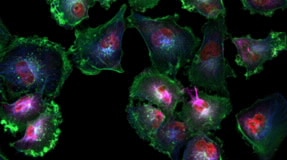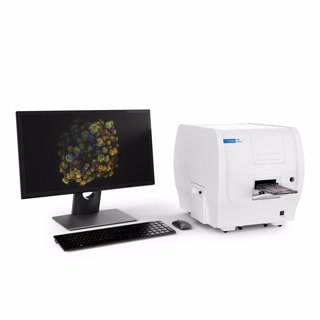
Visualize your 3D biology with Cytation 9
BioTek Cytation 9 Cell Imaging Multimode Reader
- Cell Imaging Multimode Readers
Request a Quote
Product Details
- Streamlined Discovery: A single, comprehensive platform that covers a diverse set of biochemical and cell-based assays.
- Richer Cellular Insights: Capture more data per well with an expanded image cube capacity and enhanced optics.
- Optimized Workflow Speed: Experience faster imaging throughput to move from raw samples to analyzed results more efficiently.
- Superior Kinetic Data: Software-controlled gas modules create a stable, monitored environment for live cell studies.
- Ready for Any Assay: The modular design grows with your lab, allowing you to add imaging modes as needs evolve.
| Automation Compatibility |
|
| Camera |
|
| Environment Control |
|
| Filter Detection Modes |
|
| Imager/Reader Options |
|
| Imaging Methods |
|
| Imaging Modes |
|
| Magnification Range |
|
| Microscope Type |
|
| Monochromator Detection Modes |
|
| Shaking |
|
| Supported Labware |
|
Variable bandwidth for sensitivity and specificity
The plate reader optics of Cytation uses a quad monochromator design with variable bandwidth. The bandwidth can be set anywhere between 9 and 50 nm in 1 nm increment. Large bandwidth settings (1) provide increased sensitivity and lower limits of detection. Small bandwidth settings (2) provide increased specificity when multiple signals are present, which reduces signal crosstalk and enhances assay performance.
Learn MoreProprietary Laser Autofocus
Laser autofocus and image-based (or software-based) autofocus are two methods of autofocus widely used in microscopy.
Learn MoreAlpha detection
AlphaScreen is a bead-based assay technology used to study biomolecular interactions in a microplate format. The acronym 'Alpha' stands for amplified luminescent proximity homogeneous assay. This platform provides a nonradioactive, homogeneous assay that has low background and high signal to background ratios.
Learn MoreCell Counting
Accurate cell counting is a critical step across a spectrum of cell biology applications. Direct cell counting uses methods that identify and enumerate individual cells, as opposed to indirect methods that estimate population sizes using biochemical methods.
Learn MoreObject Tracking
With the incorporation of the object tracking module, available within Agilent BioTek Gen5 software for imaging and microscopy, this can be easily accomplished in a fully automated fashion.
Learn MoreAutomatic Region of Interest Identification
This process enables walk-away slide scanning for four or more slides, if combined with Agilent automation offerings, and can be used with the Agilent BioTek Lionheart automated microscopes and Agilent BioTek Cytation imaging multimode readers.
Learn MoreSpot Counting
The spot counting module available in Agilent BioTek Gen5 software enables the number of spots counted, and other information, to be tied to the original primary mask data, allowing these values to be known for each object initially identified in the image.
Learn More- Key Literature
-
Download Literature
Download a product brochure or data sheet
- Brochures
- English
- 23 Nov 2021
- 72.95 KB
- Application Notes
- Specifications
Image Gallery
Click here to view our Image Gallery, including images captured with Agilent BioTek instruments.
Agilent Cell Analysis Publication Database
Search scientific publications by research area, cell type and more.
Agilent Cell Analysis Webinars
Featured webinars help you stay informed about timely cell analysis research topics.
Videos
- FAQs
-
Microplate Readers - FAQs
Answers to frequently asked questions about microplate readers in general and Agilent BioTek multimode and absorbance readers specifically.
Imaging & Microscopy - FAQs
Commonly asked questions and answers about Agilent BioTek cell imaging multimode readers, automated microscopes and software for imaging & microscopy.