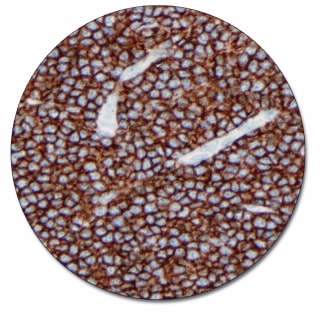
CD20 is a transmembrane, non-glycosylated protein expressed on B-cell precursors and mature B cells, but is lost following differentiation into plasma cells. In resting B cells, CD20 appears in a 33 kDa non-phosphorylated form. After mitogen stimulation, CD20 becomes heavily phosphorylated (35-37 kDa isoforms), and it is a dominant phosphoprotein in activated B cells. The antibody reacts with an intracytoplasmic epitope localized on the CD20 antigen and labels cells of the B-cell lineage. It is a useful aid for classification of neoplasms of B-cell derivation.
This product is not available for purchase by the general public.
Product Details
Features
Optimized staining performance of both high and low-expression structures
Crisp and clear staining with no background
Optimal laboratory efficiency with ready-to-use antibodies on Autostainer Link 48
The staining performance of all antibodies has been defined, tested and approved through collaboration with leading international pathologists. Check the Atlas of Stains - a guide to diagnostic accuracy.
Specifications
Application
Formalin
HIER
Clone
L26
Code Number
IR604
Immunogen
Human tonsil B cells (4). See package insert for reference(s).
Isotype
IgG2a, kappa
Reagent Provided
Ready-to-use monoclonal mouse antibody provided in liquid form in a buffer containing stabilizing protein and 0.015 mol/L sodium azide.
Clone: L26 (1, 4). Isotype: IgG2a, kappa.
Solutions
Autostainer Link 48
Species
Mouse Anti-Human
Specificity
Anti-Human CD20cy, clone L26, was clustered as anti-CD20 at the Fifth International Workshop and Conference on Human Leucocyte Differentiation Antigens (2). SDS-PAGE analysis of immunoprecipitates formed between 125I-labeled tonsil cell lysate and the antibody shows reaction primarily with 30 kDa and 33 kDa polypeptides (4). Studies using COS-1 cells transfected with cDNA encoding the CD20 molecule, indicate that the antibody labels an intracytoplasmic epitope localized on the CD20 molecule (5). See package insert for reference(s).