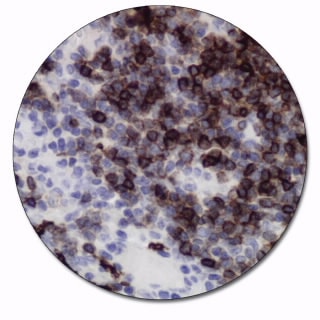
CD1a, a member of the CD1 antigen family, is a non-polymorphic MHC class I-related cell surface glycoprotein expressed in association with β2-microglobulin. Langerhans' cells, interdigitating dendritic cells and medullary thymocytes in thymic medulla are labeled by anti-CD1a. This antibody is a useful aid for classification of thymomas and malignancies of T-cell precursors.
This product is not available for purchase by the general public.
Product Details
Features
Optimized staining performance of both high and low-expression structures
Crisp and clear staining with no background
Optimal laboratory efficiency with ready-to-use antibodies on Autostainer Link 48
The staining performance of all antibodies has been defined, tested and approved through collaboration with leading international pathologists. Check the Atlas of Stains - a guide to diagnostic accuracy.
Specifications
Application
Formalin
HIER
Clone
010
Code Number
IR069
Immunogen
Human thymus cells.
Isotype
IgG1, kappa
Reagent Provided
Ready-to-use monoclonal mouse antibody provided in liquid form in a buffer containing stabilizing protein and 0.015 mol/L sodium azide.
Solutions
Autostainer Link 48
Species
Mouse Anti-Human
Specificity
Anti-Human CD1a, clone O10, was clustered as anti-CD1a at the 4th International Workshop and Conference on Human Leucocyte Differentiation Antigens (2). Clone O10 has been shown to immunoprecipitate labeled CD1a from thymus cell lysate and from Langerhans' cell-enriched epidermal cell lysate (2). In the latter, the antibody strongly precipitated the native CD1a molecule (49 kDa molecular weight) and ß2.-microglobulin (12 kDa molecular weight) but not the trypsin-cleaved CD1a molecule (27 kDa molecular weight) (2). In IHC, the antibody has been demonstrated to react with the CD1a cell surface glycoprotein expressed on cortical thymocytes, Langerhans' cells, and interdigitating dendritic (reticulum) cells in frozen and formalin-fixed, paraffin-embedded (FFPE) tissues (1, 2). See package insert for reference(s).