Excellent calibration linearity was obtained for all analytes, with correlation coefficients (R) of 0.9998 or higher across the working range. Instrument detection limits (IDLs), calculated as three times the standard deviation of the calibration blank (n = 10), were in the sub-ng/L range. Even after accounting for the 500× dilution factor, detection limits remained well below the certified concentrations of the basalt CRM. These results demonstrate that the 7850 ICP-MS provides sufficient sensitivity for REE measurement, supporting both trace‑level geochemical studies and routine exploration workflows.
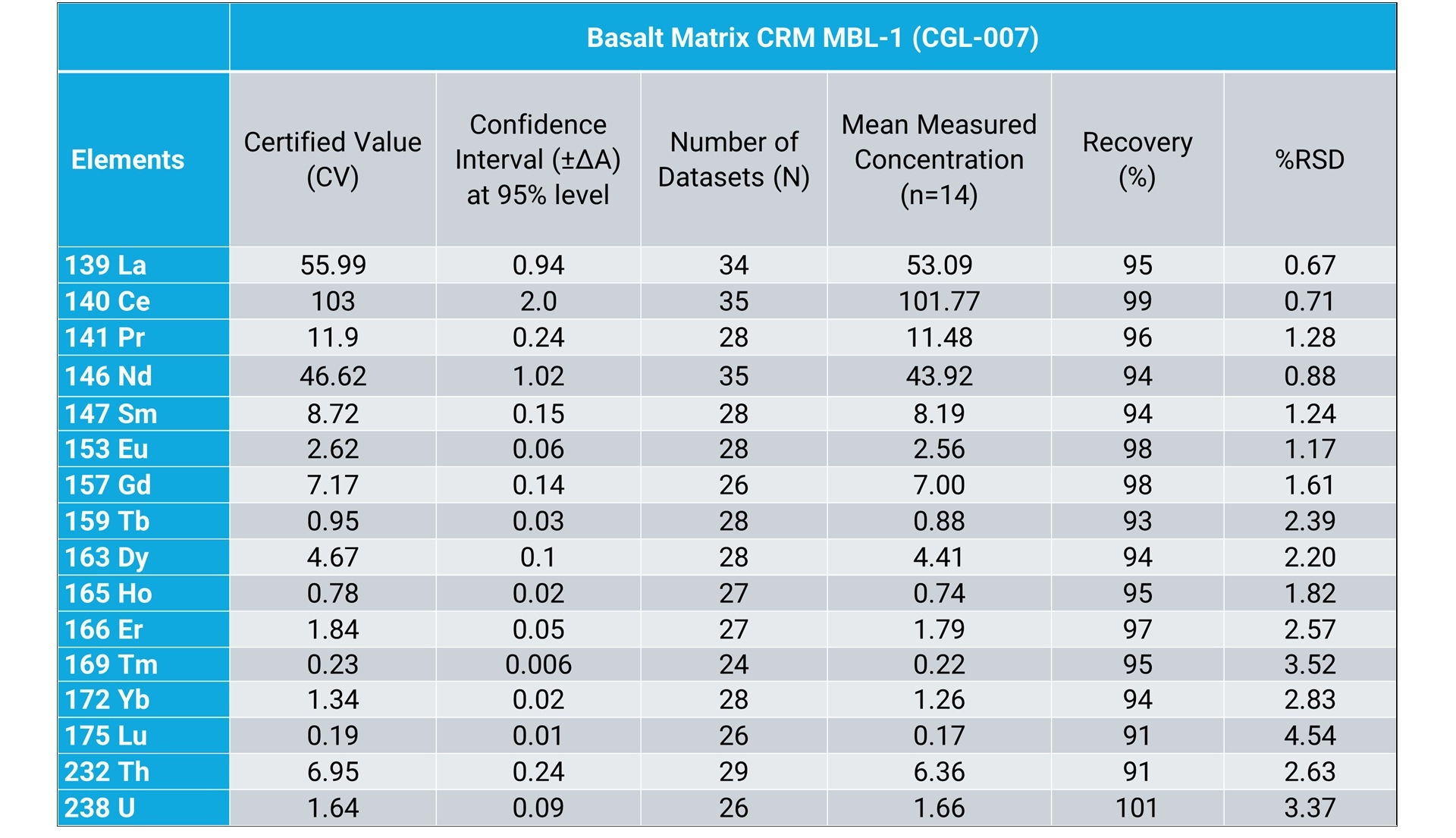
The accuracy of the method was assessed by comparing measured concentrations with certified reference values. All 16 elements were recovered within 91–101% of their certified values. Most lanthanides showed recoveries between 94 and 99%, while thorium and uranium were recovered at 91 and 101%, respectively.
Precision was equally impressive, with relative standard deviations (RSDs) typically below 3% across replicate measurements. Even lower-abundance elements such as Tm and Lu demonstrated acceptable precision within expected limits in complex geological matrices.
The results in Table 1 confirm that the 7850 ICP-MS in He mode effectively mitigated oxide and matrix-based interferences, allowing accurate quantification across the full lanthanide series.
Long-term stability
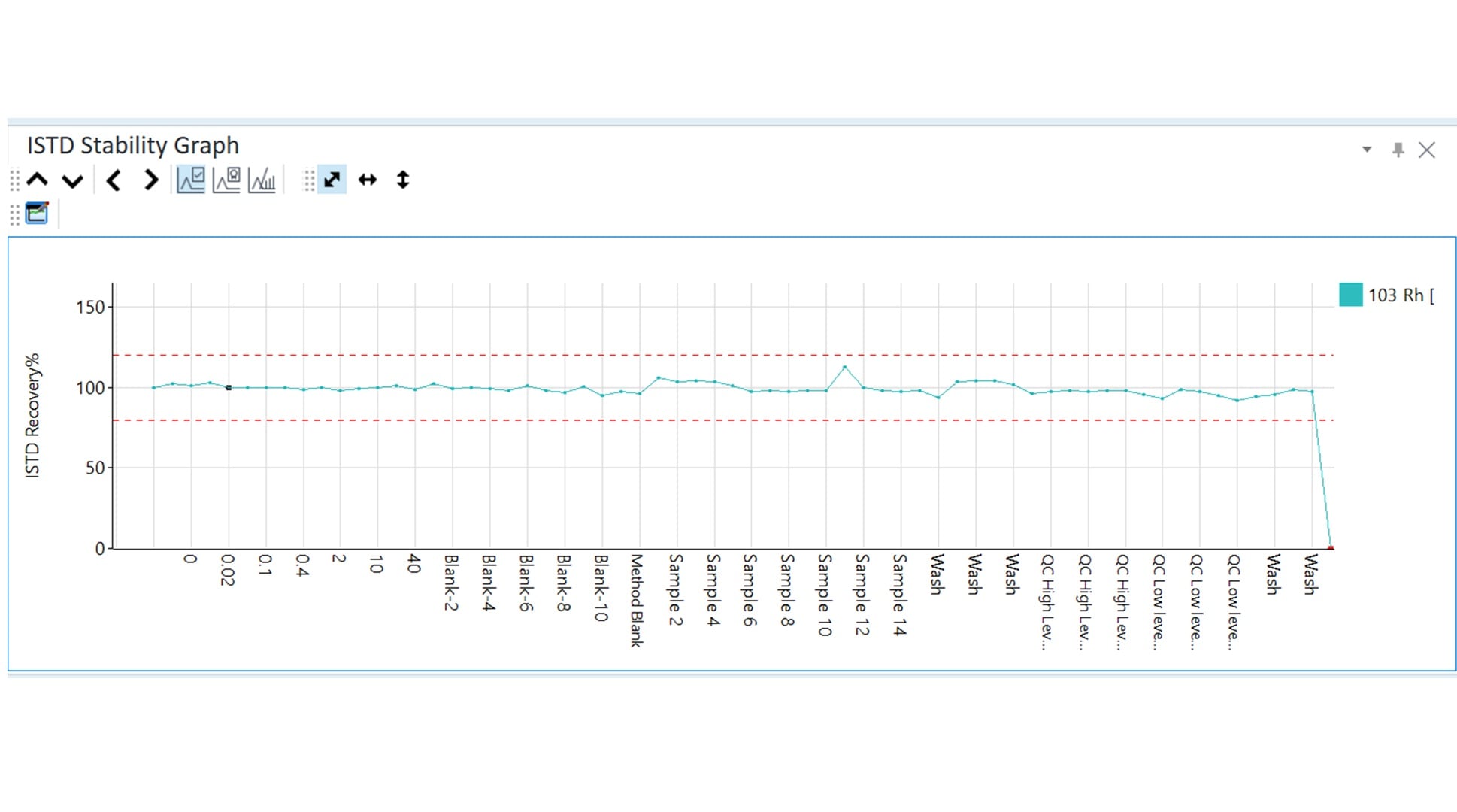
ISTD stability is a critical indicator of plasma robustness and matrix tolerance. Recoveries of the Rh ISTD were monitored over 70 analyses spanning a three-hour analytical sequence. (Rh was used as the ISTD as it was not present in the basalt CRM, unlike other potential ISTD elements such as lithium and scandium.) All internal standard recoveries remained within ±20% control limits, demonstrating excellent signal stability (Figure 2)
Routine REE determination
The results of this study illustrate the practical advantages of the 7850 ICP-MS in He mode for the routine determination of REEs in basalt. Unlike reactive gas modes, He mode simplifies method development by allowing all analytes to be measured under a single set of cell conditions. This approach reduces method complexity, improves reproducibility, and facilitates easy transfer between laboratories.
For geological laboratories, operational simplicity is often as important as analytical performance. The combination of the General Purpose preset method, automated lens tuning, and stable He KED operation significantly reduces instrument setup time and the need for operator intervention. This ease-of-use ensures consistent performance even in laboratories with varying levels of operator expertise.
From a productivity standpoint, the demonstrated long-run stability minimizes QC failures, repeat analyses, and instrument downtime. The ability to maintain accurate results over extended sequences directly supports high-throughput environments, such as exploration laboratories and research facilities that process large sample batches.
Moreover, the cost-effectiveness of quadrupole ICP-MS compared to high-resolution or multi-collector systems makes the 7850 ICP-MS an attractive solution for laboratories seeking reliable REE quantification without the complexity or expense of more specialized instrumentation.