InfinityLab Pro iQ Mass Detector
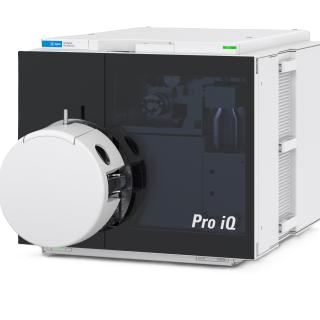
Adding mass detection to your lab’s analytical toolbox can dramatically increase analytical confidence. The Agilent InfinityLab Pro iQ Mass Detector enables you to quickly confirm compounds and provide more specificity and selectivity than a UV detector, even for compounds that are chromatographically unresolved. With a mass range of m/z 2–1,600 and an IDL sensitivity below 70 fg (ESI), the Pro iQ delivers strong analytical performance in a compact, efficient design.
The InfinityLab Pro iQ Mass Detector provides sustainable features such as:
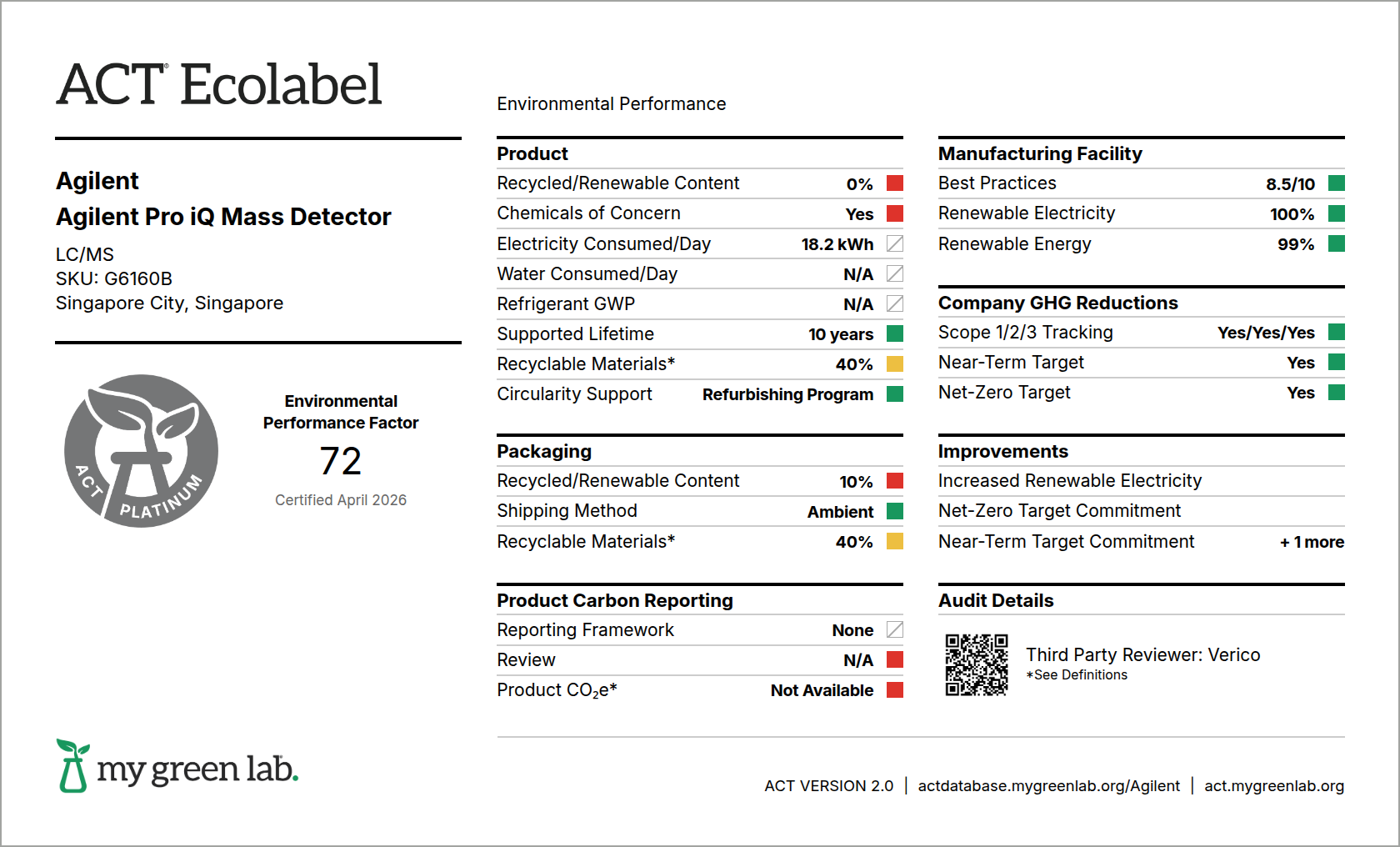
- Manufactured in a facility using 100% renewable electricity
- Made of 40% recyclable material (aluminum and steel)
- Packaging made of 40% recyclable material
- Energy-efficient, oil-free pump
- Minimum expected lifetime of 10 years
- End-of-life take-back incentives to ensure proper recycling
Additional Information
Product
Recycled/Renewable Content
The total Product Recycled/Renewable Material Content is rounded down to the nearest 10%.
Chemicals of Concern
The product has at least one chemical on the EU REACH SVHC Candidate List, or information was not provided. The product is compliant with the EU RoHS Directive (or equivalent).
Electricity Consumed/Day
Electricity consumption is determined by the product performance in a typical use case scenario. The use case scenario represents one of many possible uses and work flows for any product that is tested. The product consumes 18.2 kWh in a typical day, as defined in use case scenario provided in the My Green Lab testing protocol or approved industry standard. Equipment does not include an automatic power-saving mode that can be activated by the user. Equipment does not include an automatic shutdown mode that can be activated by the user Protocol used by the manufacturer for energy metering of the equipment: My Green Lab-approved Test Protocol
Water Consumed/Day
Water consumption is determined by the product performance in a typical use case scenario. The use case scenario represents one of many possible uses and work flows for any product that is tested. The equipment does not consume water.
Refrigerant GWP
The product does not use a chemical refrigerant or chemical insulator.
Supported Lifetime
The most common length of product support by the manufacturer is 10 years. The company provided information on product lifetime support that is available in key markets.
Product End of Life Recyclable and Compostable Materials
Note that the presence of commonly recyclable or compostable material(s) in the product does not confirm that the material(s) may be readily recycled or composted in the form/configuration found in the product. The total Product End of Life Recyclable and Compostable Materials are rounded down to the nearest 10%. The product contains commonly recyclable materials including Aluminum and Steel (all types).
Circularity Support
At product end of life, the most common product circularity support is Manufacturer-Facilitated/Supported Program for an End-of-Life outcome of Diversion to Equipment Refurbishing, Repair, Parts Sourcing. The company provided information on circularity support that is available in key markets.
Packaging
Recycled/Renewable Content
The total Packaging Recycled/Renewable Material Content is rounded down to the nearest 10%. The packaging contains sourced components with recycled/renewable content.
Shipping Method
The product is shipped at ambient temperature.
Packaging End of Life Recyclable and Compostable Materials
Note that the presence of commonly recyclable or compostable material(s) in the packaging does not confirm that the material(s) may be readily recycled or composted in the form/configuration found in the packaging. The packaging contains commonly recyclable materials including Steel (all types) and Cardboard.
Product Carbon Reporting
Available cradle-to-gate product CO2e results may be used for estimates that support Scope 3 calculations. Note that product carbon footprint results may not be directly comparable between products in the absence of a product category rule (PCR), even when using an approved reporting framework.
Facility
Best Practices - Culture of Sustainability
The facility has ISO 14001 Certification, My Green Lab Certification at Bronze or better achievement level, and at least three on-site facility employees who are My Green Lab Ambassadors. The facility provided square footage and product information to further understanding of energy intensity in life sciences manufacturing.
Best Practices - Climate and Energy
The facility has reduced GHG emissions by at least 8.8% yearly from a qualifying baseline year.
Best Practices - Waste Diversion
The facility has diverted at least 90% of waste from landfill. The facility has waste diversion from landfill to options that may include waste to energy and Incineration.
Best Practices - Water Use Reduction
Not Applicable
Renewable Electricity
The facility sources renewable electricity using financial mechanisms including EAC International Renewable Energy Certificates (I-RECs).
Renewable Energy
Facility energy use is the sum of the electricity consumed by the facility plus any other non-electricity energy source that is consumed by the facility. Non-electricity energy sources are often fuels used for heating, but may also be renewable energy sources.
On-site Renewable Electricity/Energy Generation
The facility generates renewable electricity on-site. The facility generates >10% of total facility electricity use and/or >10% of total facility energy use on-site.
Manufacturing/Assembly Facility
The facility of origin for this product is best described as a manufacturing facility, with >60% by weight of the product being manufactured at the site.
Company GHG Reductions
Scope 1/2/3 Tracking
The company tracks Scope 1 and Scope 2 GHG emissions. The company has third-party verification of its Scope 1 and Scope 2 GHG emissions to limited assurance or better. The company tracks Scope 3 GHG emissions. The company has identified all relevant Scope 3 categories. The company has third-party verification of its Scope 3 GHG emissions to limited assurance or better.
GHG Reduction Targets
The company has disclosed public GHG reduction target(s). The company GHG reduction target is aligned with Near-Term (2030) and/or Net-Zero (2050) Guidance. The company has a Near-Term GHG reduction target. The company has had its Near-Term GHG reduction target validated by a qualified standard setting organization. The company has a Net-Zero GHG reduction target. The company has had its Net-Zero GHG reduction target validated by a qualified standard setting organization.
Improvements
Recent Product Improvements Include
Recent Facility Improvements Include
The facility has a 30%+ increase in Facility Renewable Electricity Use Within 3 Years Prior to Year of Audit The facility has a 30%+ increase in Facility Renewable Energy Use Within 3 Years Prior to Year of Audit
Recent Company Improvements Include
The company has an addition of publicly announced Near-Term Target Commitment aligned with SBTi or other credible Target Setting Organization Within 3 Years Prior to Year of Audit. The company has an addition of publicly announced Net-Zero Target Commitment aligned with SBTi or other credible Target Setting Organization Within 3 Years Prior to Year of Audit.
Supporting resources
DE-014686