OpenLab Sync (formerly SLIMS) is a unified system for managing NGS samples, workflows, and data across the sample lifecycle. It combines laboratory information management system (LIMS) and workflow management capabilities to support end-to-end sample tracking, process automation, and integration across instruments and other systems in the lab.
Faster to deploy and easier to configure than traditional LIMS, OpenLab Sync provides a clear view of sample status and workflow progress with traceability across the sequencing process.
OpenLab Sync advantages for NGS
- Connect your NGS instruments
- Streamline compliance with HIPAA, CLIA, CAP and more
- Automate metadata recording and reporting
- Visually track massive volumes of sample data
- Organize boundless tasks
- Manage access rights easily
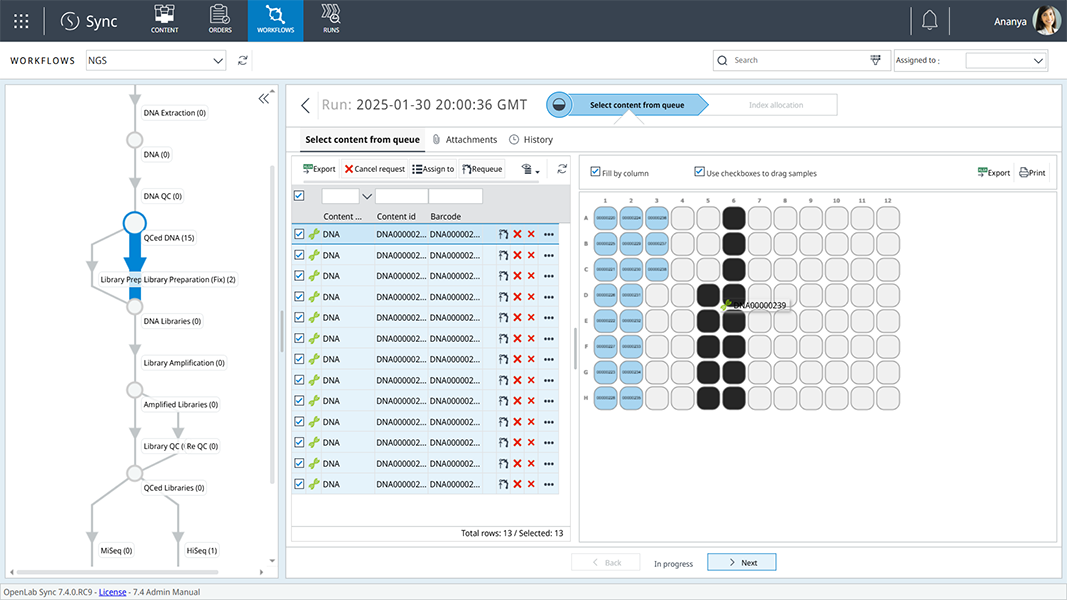
OpenLab Sync for NGS combines the best of a LIMS and NGS workflow management capabilities. Point-and-click automation facilitates the entire pipeline, instructing the user what to do—from order creation to variant analysis—with integration from Agilent Alissa Interpret. Now you can manage samples from one stage to another, track location and assignment, receive guidance for complex workflows, review by exception, and facilitate collaboration without creating delays. OpenLab Sync is also exceptionally adaptable, so it is easy to configure to match your lab’s unique processes. OpenLab Sync allows lab staff to track every step of the sample management process and find paths to all relevant content. It provides:
- Tracking from receipt to storage and delivery
- Chain of custody tracking of all locations at all times
- Flexible metadata for samples
- Usage tracking and stock management for standards and reagents
- Derivations, aliquoting, and mixing (pooling)
- Printing of custom labels and barcodes to make it easy to find anything in the lab
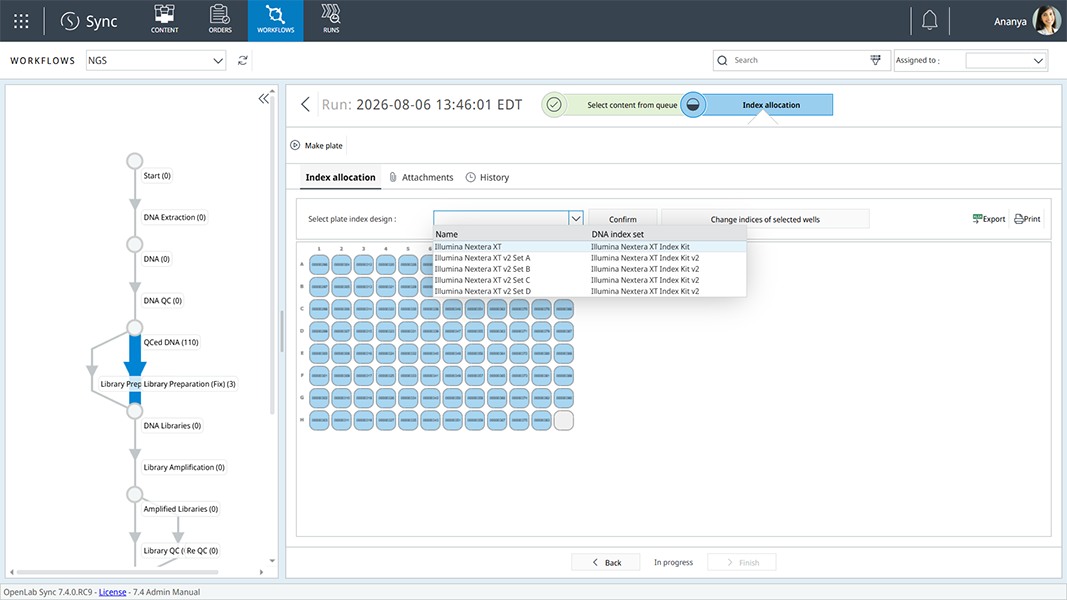
With OpenLab Sync for NGS, one automated system supports your entire NGS workflow. Quickly and easily integrate your samples, plates, assays, and instruments. Index plates are already available and can be re-configured in any order. Simply choose your kit and OpenLab Sync installs the workflow, reagents, and adapter barcodes!
Index sets from major providers
OpenLab Sync provides index sets for Agilent SureSelect, Illumina Nextera XT, BGI, and 10x Genomics, and more. Uploading a custom set is easy and can be done through Excel. Let OpenLab Sync suggest the adapter plate to apply to your sample plate in the workflow.
- Seamlessly integrate with your EMR (electronic medical record) using easy OpenLab Sync plugins that are designed
- Download our plugins from the OpenLab Sync Store to generate sample sheets and import results from NGS QC
- Use our core sequencing workflows to integrate with sequencing instruments, Illumina BaseSpace.
- Use the OpenLab Sync API to connect seamlessly with your own data pipeline.
Workflow automation
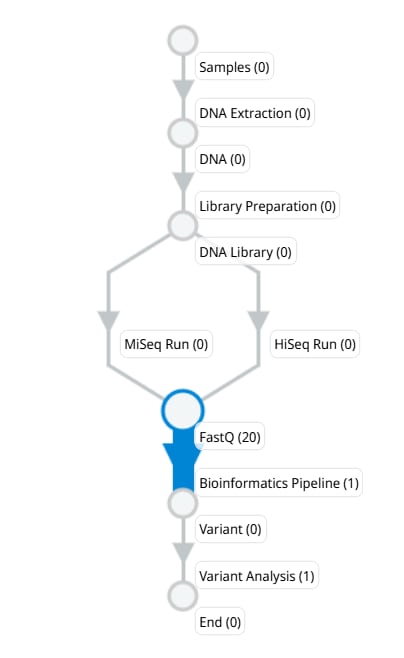
OpenLab Sync makes it easy to automate previously manual processes to increase efficiency and reduce errors, you can add new requests to samples from workflow, automate the addition of control samples, and apply rules to validate pools and storage. Just point and click to add a wide range of protocols like DNA/RNA extraction, library preparation, QC, normalization, pooling, and sequencing.
The primary difference between NGS and first-generation sequencing is throughput. NGS offers parallel sequencing of millions of small fragments of DNA per run. With conventional sequencing, or Sanger sequencing, only a few bases can be decoded per reaction using a time-consuming analysis. To give an example of the volume and throughput improvements, NGS can sequence an entire human genome in a single day, while the Sanger sequencing method that was used to decider the first human genome took more than a decade to decode. The massive improvement in throughput for NGS also led to a dramatic decrease in DNA sequencing costs.
OpenLab Sync is visual, intuitive, and easy to use. It gives you a graphical, up-to-date view of the entire workstream or any part of it, so users can always see what’s happening and what’s next on their to-do list. No more sorting through data and tasks that aren’t relevant to them.
With the graphical interface, it is simple to create and filter content. Users can customize which content to display, see all sample attributes—such as unique identifier, content type, and status—modify attributes, and see any changes from the original content, including who made the change and date and time of the change, in a way that helps you meet your 21 CFR part 11 compliance obligations. For example, you can see immediately how many samples are in process within a certain protocol type. By clicking on any item, you are directly routed to the corresponding protocols so you can start or continue your work or review what has been done. Just open OpenLab Sync to start your work or review your tasks.
OpenLab Sync for NGS is a one-stop-shop for data. It consolidates your samples and data in one place. It makes data instantly accessible to authorized lab personnel and managers, even remotely—in multiple time zones and for multi-site labs. OpenLab Sync architecture scales to meet the requirements of data-intensive or complex workflows. You always have the storage space you need and the ability to reliably organize what you collect. And by doing so digitally and automatically, you produce results that are more consistent, higher in quality, and easier to audit.
Benefits in the lab

Frequently asked questions
What is NGS?
Next-generation sequencing (NGS) refers to high-throughput, massively parallel sequencing technologies for studying genetic variation associated with disease or other biological research. NGS improves upon chain termination sequencing, or Sanger sequencing, which revolutionized biological research, allowing researchers to determine genome sequences for the first time.
What is the difference between sequencing and next-generation sequencing?
The primary difference between NGS and first-generation sequencing is throughput. NGS offers parallel sequencing of millions of small fragments of DNA per run. With conventional sequencing, or Sanger sequencing, only a few bases can be decoded per reaction using a time-consuming analysis. To give an example of the volume and throughput improvements, NGS can sequence an entire human genome in a single day, while the Sanger sequencing method that was used to decider the first human genome took more than a decade to decode. The massive improvement in throughput for NGS also led to a dramatic decrease in DNA sequencing costs.
What does an NGS LIMS do?
All laboratory information management systems (LIMS) for NGS allow users to manage samples and associated data more easily and effectively. For any NGS workflow, a good LIMS can:
- Streamline compliance with HIPAA, CLIA, CAP, and other standards
- Visually track massive volumes of sample data
- Connect your NGS instruments
- Eliminate the need to search for slow and disconnected Excel data
- Automate metadata recording and reporting
- Organize boundless tasks
- Manage variant analysis for tertiary analysis
What are the steps of an NGS workflow?
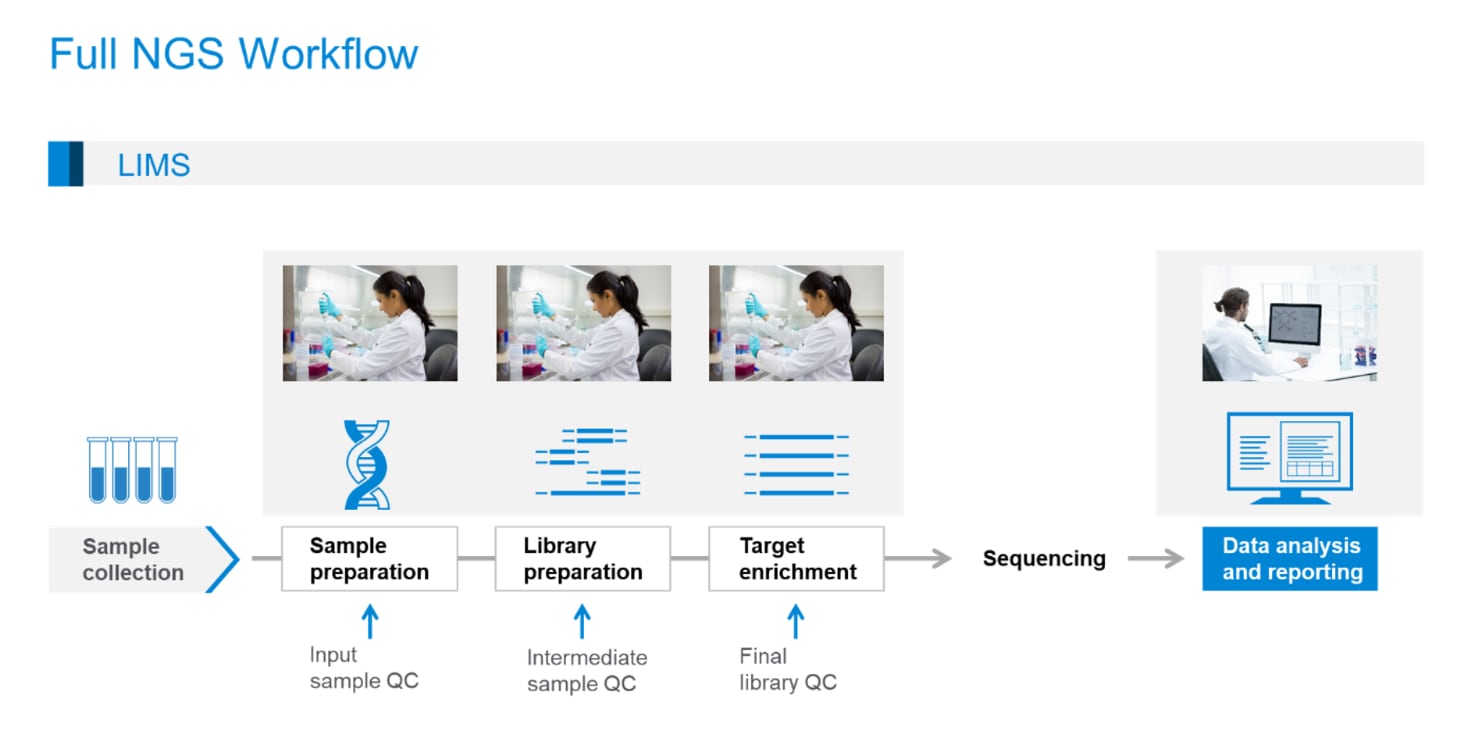
NGS is a complex scientific process that covers many steps, with QC checks along the way to ensure high-quality, consistent data. These steps include:
A. Sample collection
B. Sample preparation
C. Library preparation
D. Target enrichment
E. Sequencing
F. Data analysis and reporting
How do sequencers communicate with LIMS?
LIMS can connect all the instruments and software packages that are used across your NGS workflow, from liquid handlers to instrumentation to NGS data analysis software. For the sequencers specifically, the instrument generates a massive amount of NGS data, which gets stored and analyzed. The LIMS then finds the key results and presents them in a report.
What are the biggest challenges of NGS labs?
There are a few common challenges that NGS laboratories face, many of which can be prevented by an Agilent product or solution.
- Challenge: Storing data in a reusable way. Solution: Agilent OpenLab Sync is beneficial for searching and creating links between samples, procedures, and sample results, compared to common spreadsheet systems, such as Microsoft Excel. While Excel is easy to use and versatile, it is less desirable for retrieving information or structuring information.
- Challenge: Ensuring the sample quality is always up to certain level. Solution: Routine QC checks can ensure sample quality. Integrated and automated sample QC is ideal for efficiency and ease of use in an NGS workflow, as is the case with Agilent TapeStation systems fully integrated with OpenLab Sync.
- Challenge: Library preparation is complex and error prone. Solution: OpenLab Sync provides intuitive controls and user guidance to set up protocols more easily and quickly, while automation can reduce contamination, errors, and costs per sample. The Agilent Bravo is a flexible liquid handling platform that can automate your NGS sample preparation, freeing up time while generating consistent data.
What certification is needed for a lab to get accreditations?
To assure compliance, an NGS lab should meet the following standards, including: HIPAA, CLIA, ISO 13485, ISO/IEC 17025, and ISO 15189.
What is NGS testing used for?
NGS is a strategy that is used to test many genes simultaneously to determine the order of nucleotides in entire genomes or targeted regions of DNA or RNA. NGS can be used to detect variants or mutations. For example, in cancer, NGS can be applied to a patient’s tumor that has been biopsied or removed.
What is the difference between PCR and NGS?
Real-time polymerase chain reaction (PCR) is an easier and more forgiving technique with limited ability to multiplex. NGS allows analysts to simultaneously determine many gene sequences while revealing exact changes. However, NGS is a more technically demanding and costly process than PCR.
Why is next-generation sequencing better than PCR?
Quantitative polymerase chain reaction (qPCR) works best for low-throughput laboratories with low target numbers. NGS is more scalable and better suited for high-throughput sequencing, and it offers higher discovery power and higher sensitivity.
OpenLab Sync for NGS labs
Decades after the invention of sequencing DNA, more than 10,000 NGS systems are installed globally. With next-generation sequencing now accepted as current-generation sequencing, labs are now facing the challenge to provide higher throughput and get more organized. Regulatory bodies also play a role, as they require laboratories to record more data and be fitted for long-term tenures. As such, there is a need for implementing a digital solution to manage the entire NGS workflow with consistency, while focusing on productivity. With OpenLab Sync, in addition to a broad NGS portfolio, Agilent provides a comprehensive software solution that manages and tracks all samples over the laboratory workflow. This includes quality control measures to be taken during sample collection, before sample use, NGS library QC, and during target enrichment. OpenLab Sync also provides the sophisticated controls needed to ensure that data remain securely sorted and accessible for years to come.
Curious how OpenLab Sync can transform your NGS operations?
Agilent has deep expertise supporting labs with digital transformation for NGS. Contact us to discuss how OpenLab Sync can fit your unique workflow and goals.
Get your custom demoWhat our clients say
Hear what our clients have to say about their experience with OpenLab Sync