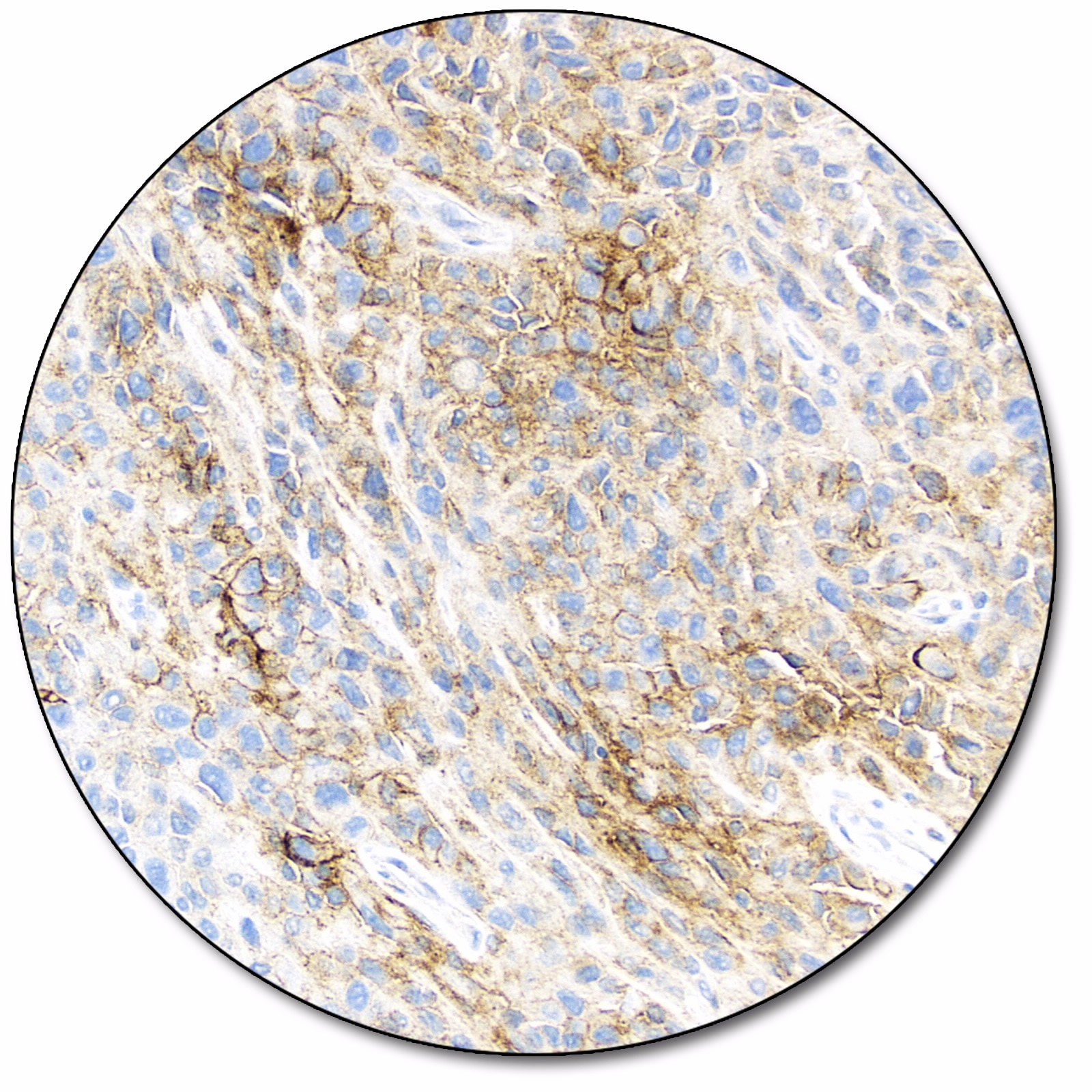
Melanoma
PD-L1 IHC 28-8 pharmDx for Autostainer Link 48
IVD

PD-L1 protein expression in NSCLC, non-squamous non-small cell lung cancer (nsNSCLC), SCCHN, UC, muscle invasive carcinoma (MIUC), melanoma, and esophageal squamous cell carcinoma (ESCC) is determined by using % tumor cell expression, which is the percentage of evaluable tumor cells exhibiting partial or complete membrane staining at any intensity.
PD-L1 protein expression in gastric adenocarcinoma, GEJ adenocarcinoma, and esophageal adenocarcinoma is determined by using Combined Positive Score (CPS), which is the number of PD-L1 staining cells (tumor cells, lymphocytes, macrophages) divided by the total number of viable tumor cells, multiplied by 100.
Non-small cell lung cancer (NSCLC)
PD-L1 expression (≥ 1% tumor cell expression) as detected by PD-L1 IHC 28-8 pharmDx is indicated as an aid in identifying early stage NSCLC patients for treatment with OPDIVO® (nivolumab) in combination with platinum-doublet chemotherapy as a companion diagnostic test.
Melanoma (OPDUALAGTM)
PD-L1 expression (< 1% tumor cell expression) as detected by PD-L1 IHC 28-8 pharmDx is indicated as an aid in identifying melanoma patients for treatment with Opdualag™ (nivolumab and relatlimab) as a companion diagnostic test.
Esophageal squamous cell carcinoma (ESCC)
PD-L1 expression (≥ 1% tumor cell expression) as detected by PD-L1 IHC 28-8 pharmDx is indicated as an aid in identifying ESCC patients for treatment with OPDIVO® (nivolumab) in combination with fluoropyrimidine and platinum-based chemotherapy or OPDIVO® (nivolumab) in combination with YERVOY® (ipilimumab) as a companion diagnostic test.
Gastric, GEJ, and esophageal adenocarcinoma
PD-L1 expression (CPS ≥ 5) as detected by PD-L1 IHC 28-8 pharmDx is indicated as an aid in identifying gastric, gastroesophageal junction, or esophageal adenocarcinoma patients for treatment with OPDIVO® (nivolumab) in combination with fluoropyrimidine and platinum-based chemotherapy as a companion diagnostic test.
Non-squamous NSCLC (nsNSCLC)
PD-L1 expression (≥ 1% or ≥ 5% or ≥ 10% tumor cell expression) as detected by PD-L1 IHC 28-8 pharmDx in non-squamous NSCLC (nsNSCLC) may be associated with enhanced survival from OPDIVO® (nivolumab).
Melanoma (OPDIVO® and YERVOY®)
PD-L1 expression (≥ 1% or ≥ 5% tumor cell expression) as detected by PD-L1 IHC 28-8 pharmDx in melanoma may be used as an aid in the assessment of patients for whom OPDIVO® (nivolumab) and YERVOY® (ipilimumab) combination treatment is being considered.
SCCHN
PD-L1 expression (≥ 1% tumor cell expression) as detected by PD-L1 IHC 28-8 pharmDx in SCCHN may be associated with enhanced survival from OPDIVO® (nivolumab).
Urothelial carcinoma (UC)
PD-L1 expression (≥ 1% tumor cell expression) as detected by PD-L1 IHC 28-8 pharmDx in urothelial carcinoma may be associated with enhanced response rate from OPDIVO® (nivolumab).
Muscle invasive urothelial cancer (MIUC)
PD-L1 expression (≥ 1% tumor cell expression) as detected by PD-L1 IHC 28-8 pharmDx is indicated as an aid in identifying MIUC patients for treatment with OPDIVO® (nivolumab) as a companion diagnostic test
PD-L1 IHC 28-8 pharmDx is subject to an exclusive trademark license to Agilent Technologies, Inc. OPDIVO®, YERVOY® and OPDUALAGTM are registered trademarks owned by Bristol-Myers Squibb.
For more details about PD-L1 IHC 28-8 pharmDx., refer to eIFU.
Reg. Status: For In Vitro Diagnostic Use
For In Vitro Diagnostic Use.

Product Details
Features
PD-L1 IHC 28-8 pharmDx kit
The kit includes reagents required for the immunohistochemical staining (except wash buffer), control slides representing different expression levels of PD-L1 protein, and detailed instructions. The kit has been tailored especially for use on Autostainer Link 48 instruments. The materials provided are sufficient for 50 tests (50 slides incubated with monoclonal rabbit antibody to PD-L1 and 50 slides incubated with the corresponding negative control reagent, 100 slides in total).
The kit includes reagents required for the immunohistochemical staining (except wash buffer), control slides representing different expression levels of PD-L1 protein, and detailed instructions. The kit has been tailored especially for use on Autostainer Link 48 instruments. The materials provided are sufficient for 50 tests (50 slides incubated with monoclonal rabbit antibody to PD-L1 and 50 slides incubated with the corresponding negative control reagent, 100 slides in total).
Featured References
- Product Description References
-
1. Borghaei, H.; Paz-Ares, L.; Horn, L.; et al. Nivolumab versus Docetaxel in Advanced Nonsquamous Non-Small-Cell Lung Cancer. N. Engl. J. Med. 2015, 373 (17), 1627–1639.
2. Phillips, T.; Simmons, P.; Inzunza, H.D.; et al. Development of an automated PD-L1 immunohistochemistry (IHC) assay for non-small cell lung cancer. Appl. Immuno. Molec. Morph. 2015, 23 (8), 541–549.
3. Ferris, R.L.; Blumenschein, G.; Fayette, J.; et al. Nivolumab for Recurrent Squamous-Cell Carcinoma of the Head and Neck. N. Engl. J. Med. 2016, 375 (19), 1856–1867.
4. Sharma, P.; Retz, M.; Siefker-Radke, A.; et. Al. Nivolumab in metastatic urothelial carcinoma after platinum therapy (CheckMate 275): a multicentre, single-arm, phase 2 trial, Lancet Oncology. 2017, 18 (3): 312–322.
5. Bajorin, D.F.; Witjes, J.A.; Gschwend, J.E.; et al. Adjuvant Nivolumab versus Placebo in Muscle-Invasive Urothelial Carcinoma. N. Engl. J. Med. 2021, 384 (22), 2102–2114.
6. Postow, M.A.; Chesney, J.; Pavlick, A.C.; et al. Nivolumab and ipilimumab versus ipilimumab in untreated melanoma. N. Engl. J. Med. 2015, 372 (21), 2006-2017.
7. Larkin, J.; Chiarion-Sileni, V.; Gonzalez, R.; et al. Combined Nivolumab and Ipilimumab or Monotherapy in Untreated Melanoma. N. Engl. J. Med. 2015, 373 (1), 23–34.
8. Doki, Y.; Ajani, J.A.; Kato, K.; et al. Nivolumab Combination Therapy in Advanced Esophageal Squamous-Cell Carcinoma. N. Engl. J. Med. 2022, 386 (5), 449–462.
9. Janjigian Y.Y.; Shitara K.; Moehler, M.; et. al. First-line nivolumab plus chemotherapy versus chemotherapy alone for advanced gastric, gastro-oesophageal junction, and oesophageal adenocarcinoma (CheckMate 649): a randomised, open-label, phase 3 trial. Lancet 2021, 398 (10294), 27–40.10. Tawbi, H.A.; Schadendorf, D.; Lipson, E.J; et. al. Relatlimab and Nivolumab versus Nivolumab in Untreated Advanced Melanoma. N. Engl. J. Med. 2022, 386 (1), 24–34.
10. Forde, P.M.; Spicer, J.; Lu, S.; et al. Neoadjuvant Nivolumab plus Chemotherapy in Resectable Lung Cancer. N. Eng. J. Med. 2022, 386, 1973–1985. DOI: 10.1056/NEJMoa2202170