
ANSES (French Agency for Food, Environmental and Occupational Health & Safety), through its Laboratory for Food Safety in Maisons-Alfort, is a COFRAC-accredited official control laboratory contributing to national food safety monitoring and risk assessment. The laboratory develops and validates multi-element ICP-MS methods for regulatory surveillance programs, including large-scale total diet studies, where reliable performance across diverse food matrices is essential.
Accuracy profile validation strategy
The accuracy profile approach described in the French standard NF V03-110 was used as an integrated strategy to validate method performance across a wide concentration range and diverse food matrices. Instead of assessing trueness and precision separately, this approach combines both parameters into β-expectation tolerance intervals, allowing verification that most future results fall within predefined acceptance limits (λ). These limits allow a visual assessment of a method’s fitness-for-purpose. The parameters also enable the determination of operational limits of quantification (LOQs) based entirely on validated analytical performance rather than on theoretical criteria or blank measurements. This global evaluation is particularly well suited to multi‑element methods applied across a broad range of diverse matrices, where performance can vary and traditional validation parameters are often insufficient to reflect real routine conditions.
The structured validation workflow applied to the 35-element ICP-MS method is summarized in Figure 1.
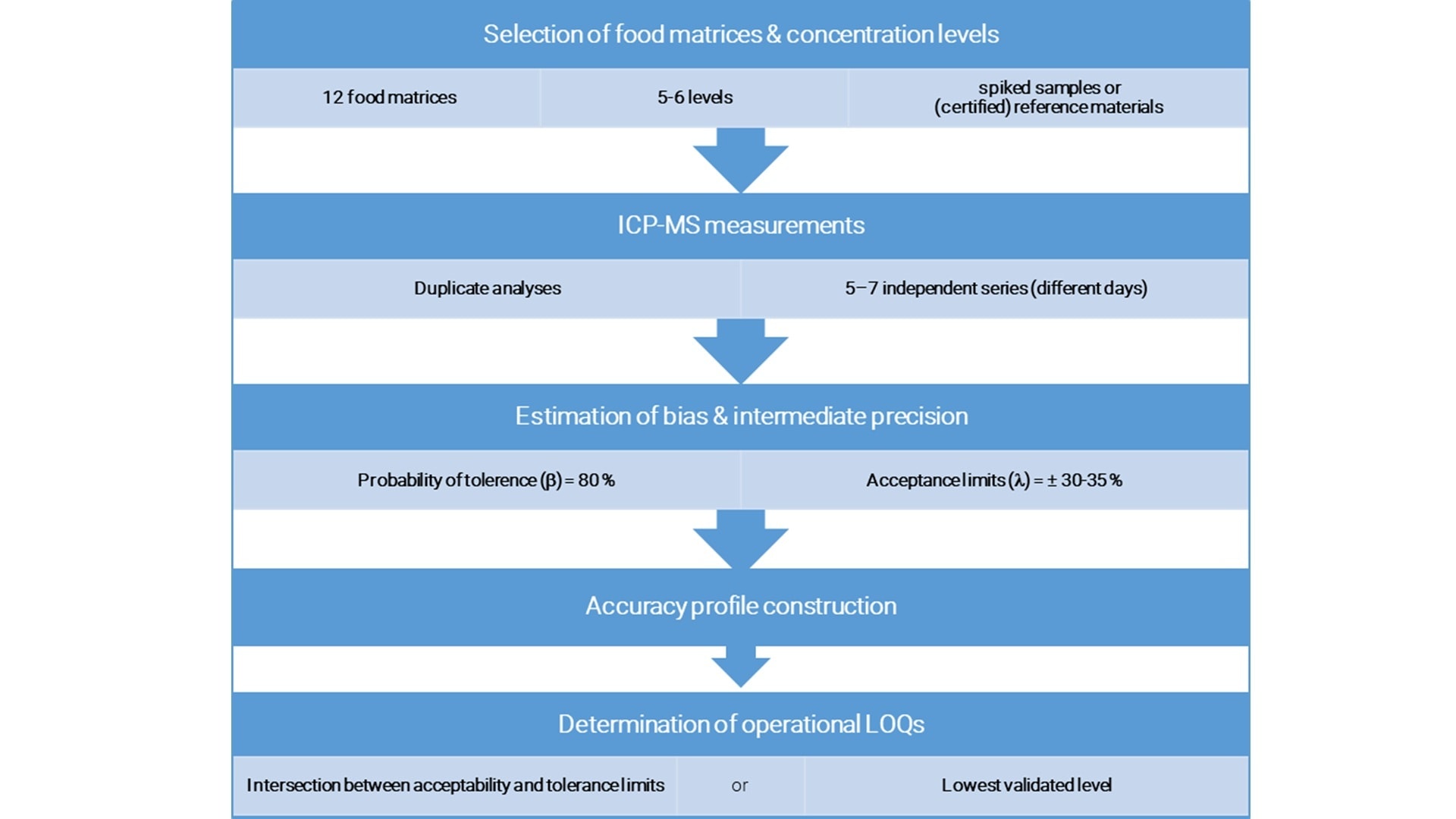
Validation was based on multiple independent analytical series comprising the analysis of certified reference materials, proficiency‑test materials, and spiked samples. The approach provides a robust assessment of bias and intermediate precision under routine conditions across major, trace, and emerging elements within a single validation framework.
Operational implementation of the multi-element ICP-MS method
The validated 35-element method was implemented as a single ICP-MS workflow combining microwave digestion, external calibration, and internal standard correction. All elements were measured within the same analytical sequence, without matrix-specific adaptations.
Instrumental conditions were deliberately simplified to ensure robust routine operation. Some elements were analyzed in standard mode (no gas), while He mode with KED was applied for certain isotopes only when the alleviation of (polyatomic) spectral interferences was necessary. Additionally, a single isotope was selected for each element, and the number of internal standards was also limited to reduce method complexity and enhance long-term run stability.
This simplified configuration enables the quantification of both major and ultratrace elements within a single method framework.
Integration of emerging elements within a simplified method
The ICP-MS method was based on a previously published work.1 However, it was extended to include four additional elements (Rh, Pd, Pt, and Tl), which are of growing interest in food chemistry due to diffuse environmental contamination, particularly from automotive catalytic converters. These elements are typically present at ultratrace levels and therefore require low operational LOQs and careful interference assessment. They were successfully incorporated into the existing method to achieve simultaneous determination of 35 elements, without introducing additional acquisition modes or increasing instrumental complexity.
Accuracy profile validation confirmed that these emerging elements met predefined acceptance limits across validated concentration ranges. This assessment demonstrates that extended monitoring capabilities can be incorporated within a unified multi-element ICP-MS workflow while maintaining robustness and analytical reliability.
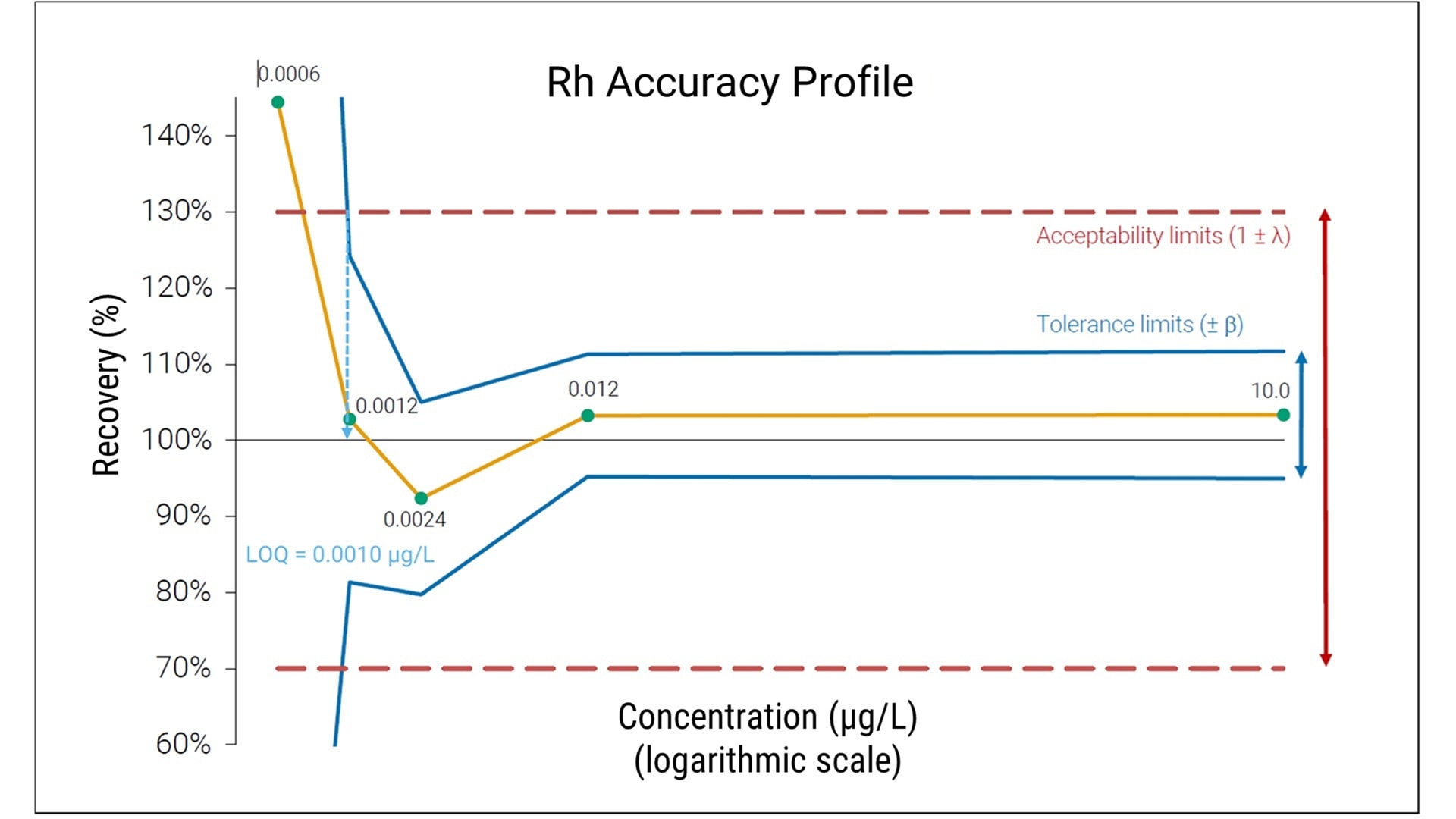
A representative accuracy profile obtained for Rh is shown in Figure 2, illustrating the validated working range and the definition of the operational LOQs.
Method performance highlights
The validated method demonstrated consistent performance across all 35 elements and tested food matrices. Accuracy profiles remained within predefined acceptance limits (± 30–35%) over the validated working ranges, covering ultratrace and trace to major elements, including emerging elements (Pt, Rh, Pd, and Tl).
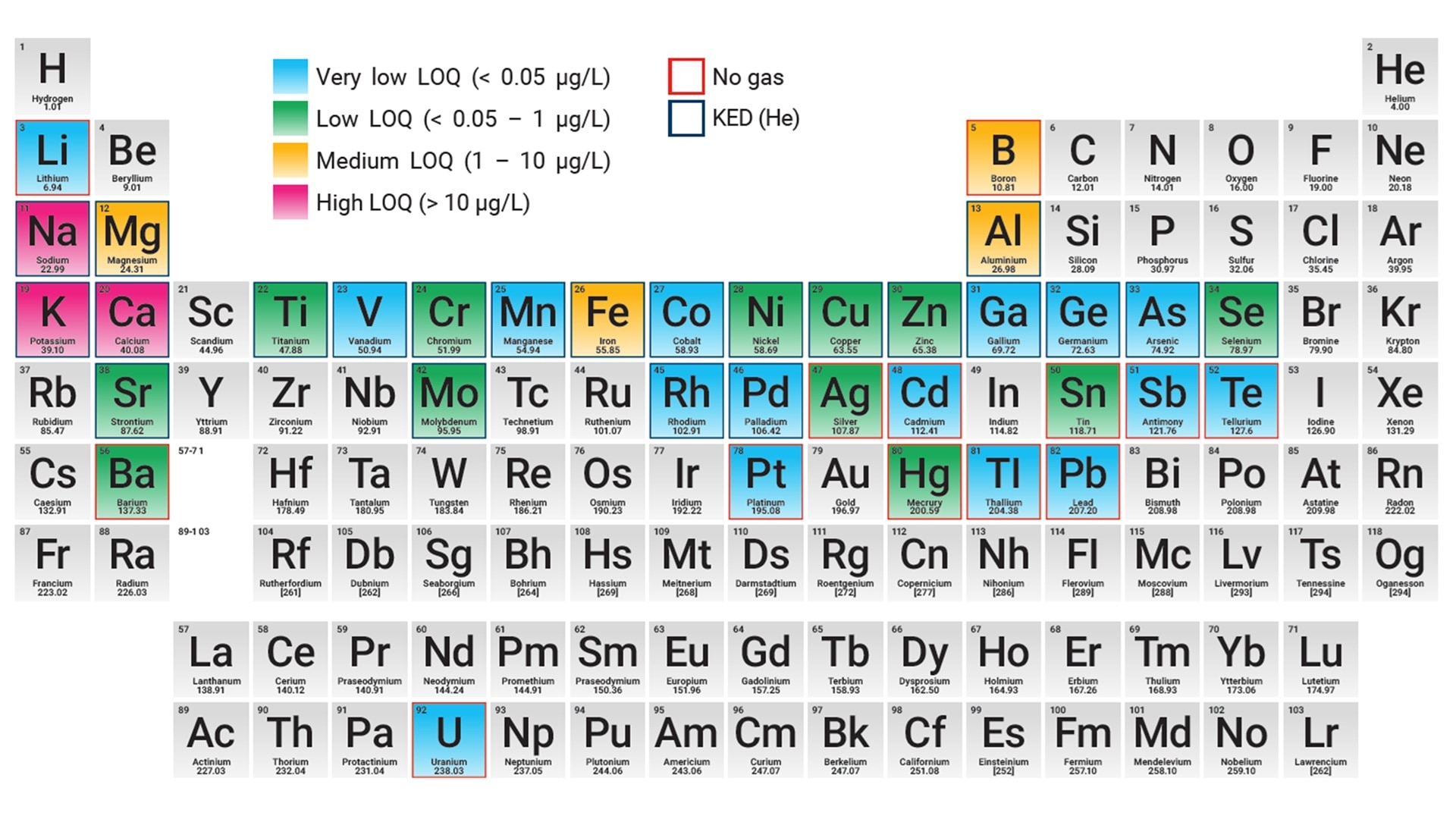
Operational LOQs spanned several orders of magnitude, from sub-µg/L levels for elements such as Cd, Hg, Pb, and Pt, to higher concentration ranges typical for major elements including Na, K, Ca, and Mg. It is worth underlining that the use of a simplified no gas and He KED configuration did not compromise the overall analytical performance, confirming effective interference control under routine conditions.
An overview of the operational LOQs achieved across the 35-element panel and the associated ICP-MS acquisition modes is presented in Figure 3.
Reference
- Chevallier, E.; Chekri, R.; Zinck, J.; Guérin, T.; Noël, L. Simultaneous determination of 31 elements in foodstuffs by ICP-MS after closed-vessel microwave digestion: Method validation based on the accuracy profile. J. Food Compos. Anal., 2015, 41, 35-41, DOI: 10.1016/j.jfca.2014.12.024
Learn More
Leufroy, A. et al. Advanced ICP-MS method for multi-element determination in food: Validation by the accuracy profile approach and application to a wide range of matrices. J. Food Compos. Anal., 149, 2026, 108711, https://doi.org/10.1016/j.jfca.2025.108711