Access Agilent eNewsletter, April 2014
>> Update My Profile | Subscribe to Access Agilent | Article Directory

Detecting off tastes and odors in drinking water at extremely low levels
By Joe Weitzel
Agilent Global Environmental Manager
Detecting off-taste and odor in drinking water is one of the principle causes of complaints from consumers to water companies around the world. Some of these chemical contaminants have very low taste and odor thresholds and can be detected by consumers at very low concentrations, although this does not necessarily indicate that there is an associated health concern. Identifying some of these chemical residues is made all the more difficult by these low taste and odor thresholds. For example, the odor threshold for geosmin is approximately 15 ng/L and for 2-methyl isoborneol (MIB) is 20 ng/L. The thresholds for 2-ethyl-5,5-dimethyl-1,3-dioxane (2-EDD) and 2-ethyl-4-methyl-1,3-dioxolane (2-EMD) are both 10 ng/L.
Odors, manmade and natural
There are many sources of off-tastes in drinking water, ranging from manmade industrial waste to natural byproducts of microbial activity, such as geosmin from cyanobacteria and biomethylation of phenolic compounds by microfungi. Biogenic odors are directly related to summer algal blooms, or can be caused by decay of organic material in surface waters. The range of perceived odors also varies, from sweet to carbolic and medicinal to musty.
Combining the use of trained taste and odor panels with rapid analytical screening methods is an effective means of taste and odor identification. We describe here a method developed for the analysis of drinking water with objectionable taste and odors, using an Agilent 7890B GC equipped with an Agilent J&W HP-5ms Ultra Inert GC column, coupled to an Agilent 7000C Triple Quadrupole GC/MS System.
 Enlarge
Figure 1. Standard chromatogram of a water sample (10 ng/L), no internal standard.
 Enlarge
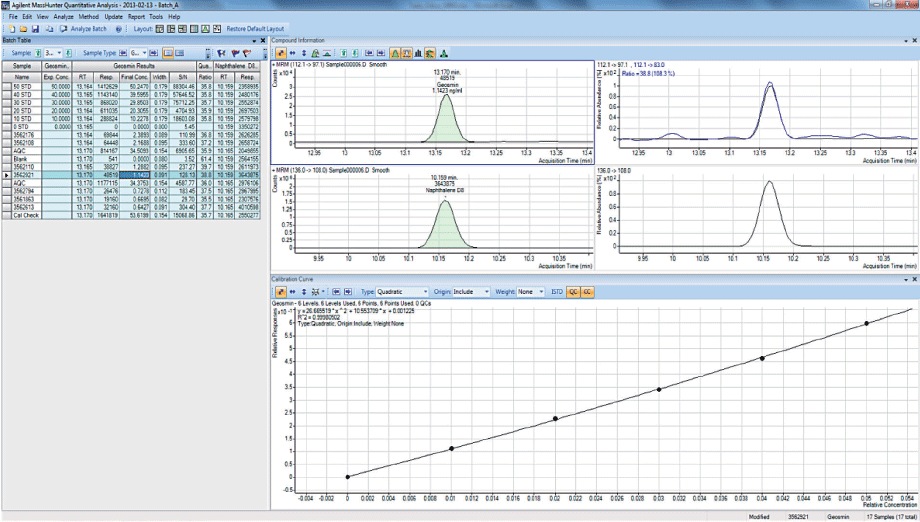
Figure 2. Agilent MassHunter Workstation display of geosmin in a water sample at a concentration of 1.1 ng/L (S/N = 128/1).
Ten liters of water sample is extracted with 100 mL of dichloromethane. The solvent is then passed through a hydrophobic membrane and evaporated down to 0.5 mL. The extract is spiked with d8-naphthalene internal standard and transferred to an autosampler vial ready for analysis by triple quadrupole GC/MS. A quality control spike at 40 ng/L is also extracted.
The method can determine 20 taste and odor compounds, with a detection limit of 1 ng/L for all compounds. Figure 1 shows a typical chromatogram of a 10 ng/L standard.
The calibration range for all the compounds was 0 to 50 ng/L, with standards at 0, 10, 20, 30, 40, and 50 ng/L. Figure 2 shows just one example of a screenshot from the Agilent MassHunter Workstation software of a typical calibration plot for geosmin. An actual sample result and the signal-to-noise ratio (S/N) measurement are highlighted. The geosmin result, at 1.1 ng/L, is close to the reporting limit of 1 ng/L with an S/N ratio of 128:1. This demonstrates that the detection limits for some compounds, should the method be fully validated to the NS30 standard of the UK Drinking Water Inspectorate, could be even lower than 1 ng/L. Full details of this method and more results are available in Agilent publication 5991-3721EN.
Protecting our drinking water
The use of extracted samples and analysis on the Agilent 7000C Triple Quadrupole GC/MS System ensures that low detection limits were achieved. In this method, the detection limits for all of the compounds are 1 ng/L. This is just one of many Agilent solutions for water analysis. You can learn more from our water analysis pages, or download your copy of the new water quality applications brochure.
>> Update My Profile | Subscribe to Access Agilent | Article Directory
Figure 1.
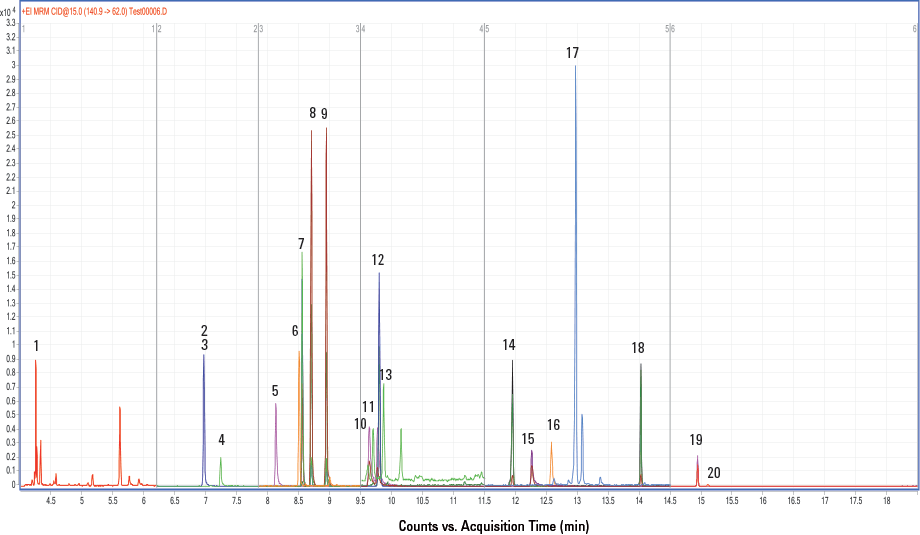
- 2-ethyl-4-methyl-1,3-dioxolane
- phenol
- 2-chlorophenol
- 2-ethyl-5,5-dimethyl-1,3-dioxane (2-EDD)
- 2-bromophenol
- 2-isopropyl-3-methoxypyrazine
- 3-chloroanisole
- 4-chloroanisole
- 2-chloroanisole
- 2,4-dichlorophenol
- 2,3-dichlorophenol
- 2-isobutyl-3-methoxypyrazine
- 2-methyl isoborneol
- 2,3,4-trichloroanisole
- 2,4,6-trichlorophenol
- 2,6-dibromophenol
- geosmin
- 2,4,6-trichloroanisole
- 2,4,6-tribromoanisole
- 2,4,6-tribromophenol.
Standard chromatogram of a water sample (10 ng/L), no internal standard.