Advanced Macromolecular Characterization

Deep insight into macromolecular properties
- New, advanced, or complexly structured macromolecules require precise, reliable, and accurate characterization. Yet, challenges in this area are faced daily in laboratories around the world. Agilent offers a variety of macromolecular analyses including deformulation analysis, substance identification and additive analysis, as well as structure and branching analysis. Coupled with these services comes state-of-the-art expertise and analytical support from our specialists, who will communicate with you directly to identify your specific needs and help you successfully achieve your project objectives.
- Deformulation analysis using a combination of analytical methods to identify and quantify components in a complex mixture
- Determination of both long- and short-chain branching of polymers
- Characterization of chemical composition distributions using interaction polymer chromatography (IPC
- Two-dimensional (2D) chromatography for correlating different structural parameters
- State-of-the-art expertise and one-on-one analytical support
Features
How it works

How to Submit a Macromolecular Sample
In order to have our specialists perform analysis of your macromolecular samples, you will need to submit them to us. There is a simple process to follow when sending your samples to us, as well as a few sample requirements.
More information on how to submit samples can be found here.
Molar Mass Analysis
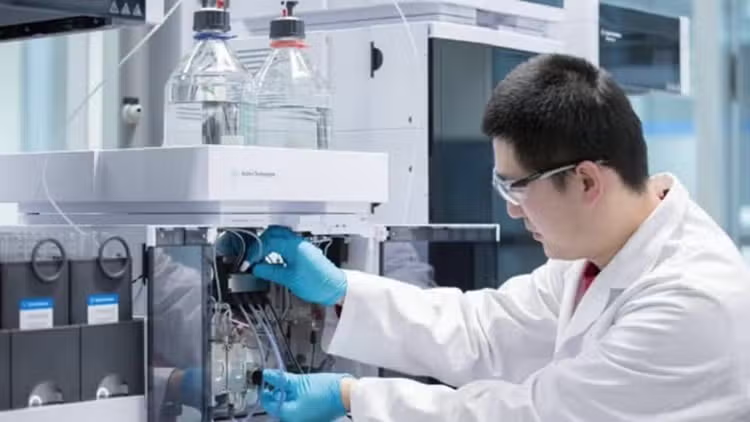
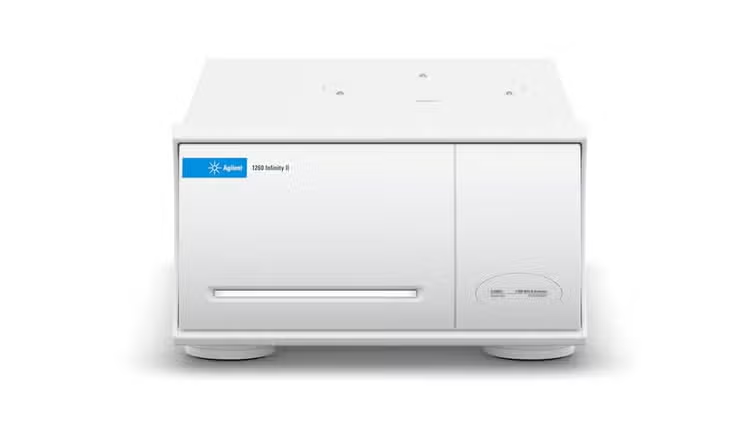
Agilent provides GPC/SEC for macromolecular characterization in a variety of solvents, including high-temperature gel permeation chromatography (HT-GPC). While conventional GPC/SEC provides relative molar masses, the addition of a light scattering or viscosity detector allows true molar masses and information like branching or aggregation to be obtained. The addition of UV or FTIR detection allows the following of chemical composition as a function of elution volume.
Our analytical services staff will work with you to select the most appropriate analytical approach for your needs.

Chemical Composition Analysis
In contrast to GPC/SEC, which separates based on molecular size, interaction polymer chromatography (IPC) allows separation based on chemical composition or end groups. Two-dimensional liquid chromatography (2D-LC) allows for deformulation analysis of complex samples. Agilent uses the following techniques:
- Chromatography under critical or limiting conditions
- Solvent or temperature gradient interaction chromatography (SGIC or TGIC)
- Gradient polymer elution chromatography (GPEC)
- Two-dimensional LC (2D-LC)
This service involves an initial consultation with our analytical services staff to determine the most effective analytical methods to use.
Applications
Aggregation analysis and GPC/SEC MALS detection
The combination of GPC/SEC with light scattering detection is a powerful technique to study the purity and interactions of (bio)polymers. While GPC/SEC allows the separation and quantification of associates such as dimers, trimers, and more, a multi-angle light scattering (MALS) detector also allows the determination of absolute molar masses of the various structures.
Polymer chain branching analysis using GPC/SEC
Branching of polymer chains strongly affects the physical polymer properties. For example, long-chain branches increase polymer strength, toughness, and the glass transition temperature. Agilent determines long-chain branching using GPC/SEC combined with viscometry and/or light scattering (LS) in a variety of solvents up to 160 °C.

Copolymer analysis
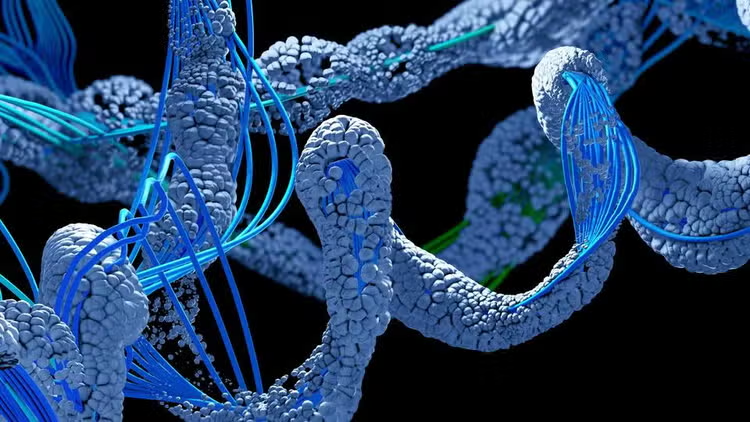
In copolymers, the monomers are not distributed identically over all polymer chains. Some chains will be rich in monomer A, while others will be rich in comonomer B. The extent of chemical heterogeneity, which depends on synthesis conditions, affects application properties of the materials. Spectroscopic techniques allow only determination of average compositions. However, macromolecular characterization techniques based on interaction chromatography or multidetection approaches allow identification of differences in chemical composition distribution.
Documents & support
Tools
News
Expanded Offerings for GPC/SEC Polymer Analysis
Agilent has acquired Polymer Standards Service GmbH (PSS), a provider of solutions for polymer characterization. PSS specializes in hardware and software solutions for gel permeation chromatography (GPC) and size exclusion chromatography (SEC). With over 35 years of expertise, they provide complete solutions for GPC/SEC applications to determine the molecular weight and size distribution of macromolecules.
Expanded Offerings for GPC/SEC Polymer Analysis / 02 Aug 2022
New Comprehensive GPC/SEC Solutions Introduced at HPLC 2023 Conference
Agilent showcased significantly expanded InfinityLab GPC/SEC Solution at the HPLC 2023 conference on June 18 – 22, 2023 in Düsseldorf, Germany. The Agilent InfinityLab GPC/SEC portfolio became even more comprehensive after the recent acquisition of Polymer Standard Service Ltd. (PSS), including a dedicated GPC/SEC Column Thermostat, a Multi-Angle Light Scattering Detector, the GPC/SEC-Ready Kit, and the powerful WinGPC Software into the already existing InfinityLab GPC/SEC Solutions for advanced material characterization.
12 Jun 2023
Explore more services
PRDT_3524527
PRDT_3571454
PRDT_3571662
PRDT_3622125
PRDT_3622138
PRDT_3622140
PRDT_3622142


