Helping Pathology Labs Enhance Efficacy and Accuracy
Pathology is a pivotal medical discipline that influences many aspects of patient diagnosis; from research and diagnosis testing to treatment recommendations and the development of personalized medicines. And as cancer rates surge globally, pathology laboratories are facing increasing test volumes of higher complexity. Coupled with workforce shortages, this generates the need for new solutions that streamline workflows, optimize processes and reduces the overall wait time from biopsy to diagnosis for patients.
But help is on hand. From automated tissue staining solutions to advances in companion diagnosis and the integration of AI and ML through digital pathology, labs can access a range of tools and solutions that can help them meet demand with enhanced accuracy.
Automated Staining Solutions
Automated, advanced tissue staining workflows can provide labs with consistent, high-quality slide staining while reducing the risk of human error. These systems accelerate sample processing, ensure reproducible results, and free up pathologists and laboratory staff to focus on more complex diagnostic tasks.
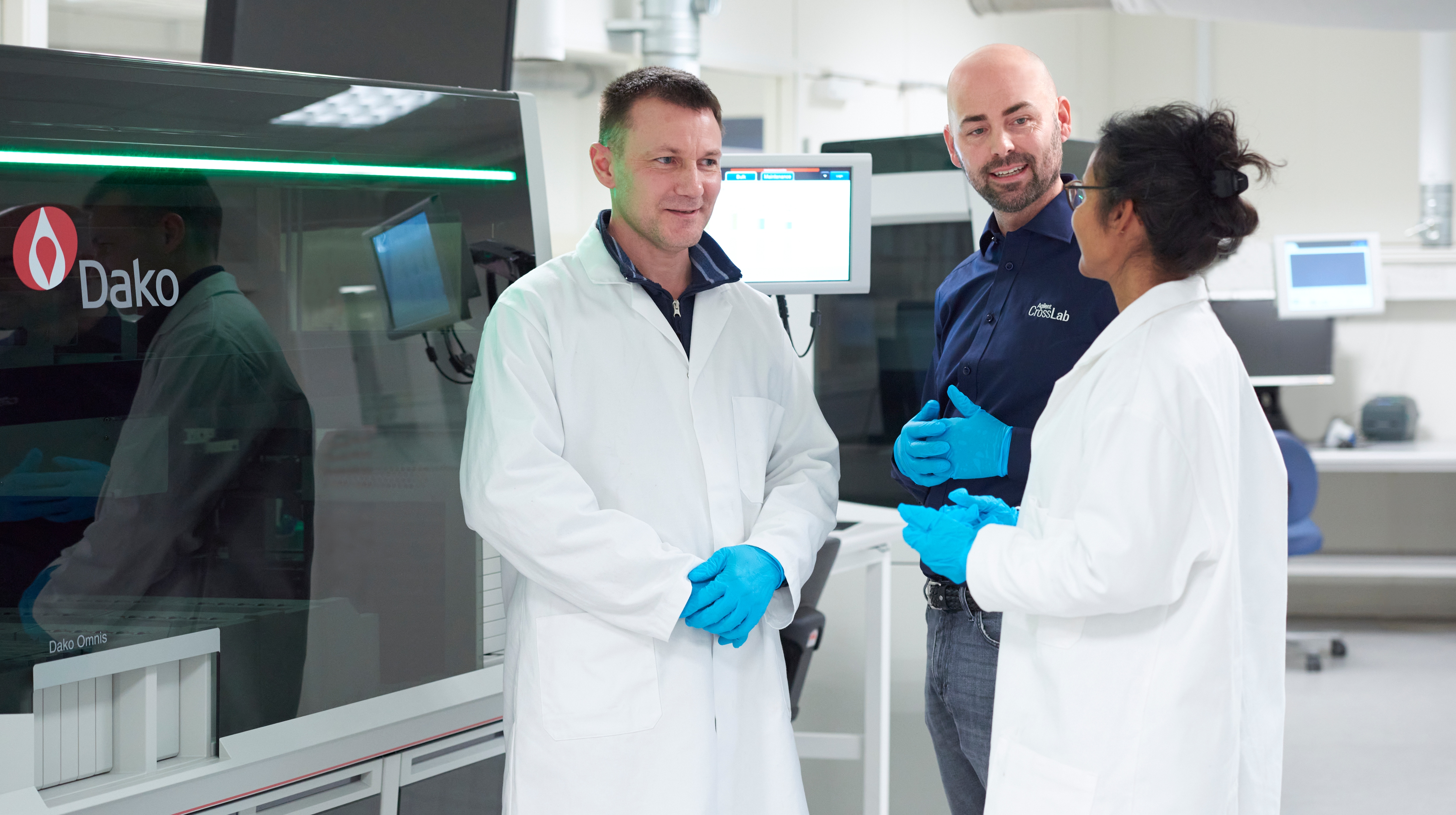
Our Dako Omnis platform provides labs with all these benefits. An advanced automated system for immunohistochemistry and in situ hybridization, this platform supports a seamless and fully automated workflow, with flexible scheduling that accommodates immediate or overnight processing based on patient needs. With a capacity of 60 slides and six independent staining units, the system is specifically designed to process a high volume of cases, reducing the need for frequent reagent changes. The platform can perform multiple tests, such as immunohistochemistry, double staining, immunofluorescence, and in situ hybridization, simultaneously within the same instrument, eliminating the need for pre-selecting specific tests.
At the Hospital of Jaén, these efficiencies are transforming the pathology service, with the Head of Service commenting:
“Since the installation of Dako Omnis in the Pathology Service of the Jaén Hospital Complex, we have seen significant improvements in the Service at different levels. In the laboratory, there has been an improvement in the work pace of the technicians, due to the ease of use of the system and its versatility. This has allowed them to manage the workload and implement new techniques such as Fluorescent In Situ Hybridization (FISH) for Myc, BCL2, and BCL6 probes. The pathologists have also seen an impact on their daily work, as we have seen a reduction in the time to complete cases, which are ready for diagnosis sooner. Additionally, we receive complete cases continuously throughout the day, not just at the end of the day, which allows us to issue diagnoses earlier and better organize our diagnostic workload."
Companion Diagnosis
Companion diagnostics (CDx) forms the cornerstone of personalized medicine by identifying patients who are most likely to benefit from specific therapies based on their genetic or molecular profiles. By providing precise insights into the biochemical basis of diseases, CDx has radically transformed cancer treatment, enabling personalized therapy plans that improve patient outcomes.
Agilent supports laboratories in CDx by providing end-to-end solutions that span assay development, regulatory compliance, and commercialization. With over 25 years of experience, we have supported the development, validation, and launch of landmark cancer therapies, delivering world-class assays that labs worldwide can trust.
For example, Agilent’s CLIA-certified Biopharma CDx Services Lab offers a streamlined, flexible, and efficient model for companion diagnostic development—from early assay development to regulatory approval. The lab provides access to advanced biomarker assessment tools and high-quality assays, supporting robust data generation for new precision therapeutics in clinical trials.
We continued to partner with pharmaceutical partners to co-develop novel biomarker-based diagnostics and integrate advanced technologies like automated staining and digital pathology to accelerate precision medicine and enhance patient outcomes.
Digital Pathology and Whole Slide Imaging
From AI-powered image analysis to advanced biomarker discovery, digital pathology has the potential to boost lab efficiency and improve diagnosis accuracy.
For example, whole slide imaging - creating high-resolution digital images of glass slides —allows pathologists to detect subtle tissue patterns and anomalies that may go unnoticed with traditional microscopy. It also simplifies image-sharing for second opinions and facilitates telepathology. Integrating AI algorithms can further amplify these advantages. Our partnership with Visiopharm empowers labs to leverage AI-driven image analysis to enhance diagnostic workflows through AI-assisted selection and detection. By applying pre-designed algorithms, we support pathologists' reviews and improve workflow efficiency.
The pathology sector is changing, and laboratories must adapt accordingly. By harnessing the right solutions, laboratories can leverage the benefits of new technologies and innovative instruments to continue their critical research and diagnostics work.
Disclaimers
Please note that these products are not available in all countries. Contact us to hear about availability in your country.
These products are not available for purchase by the general public.