AI Peak Integration for MassHunter
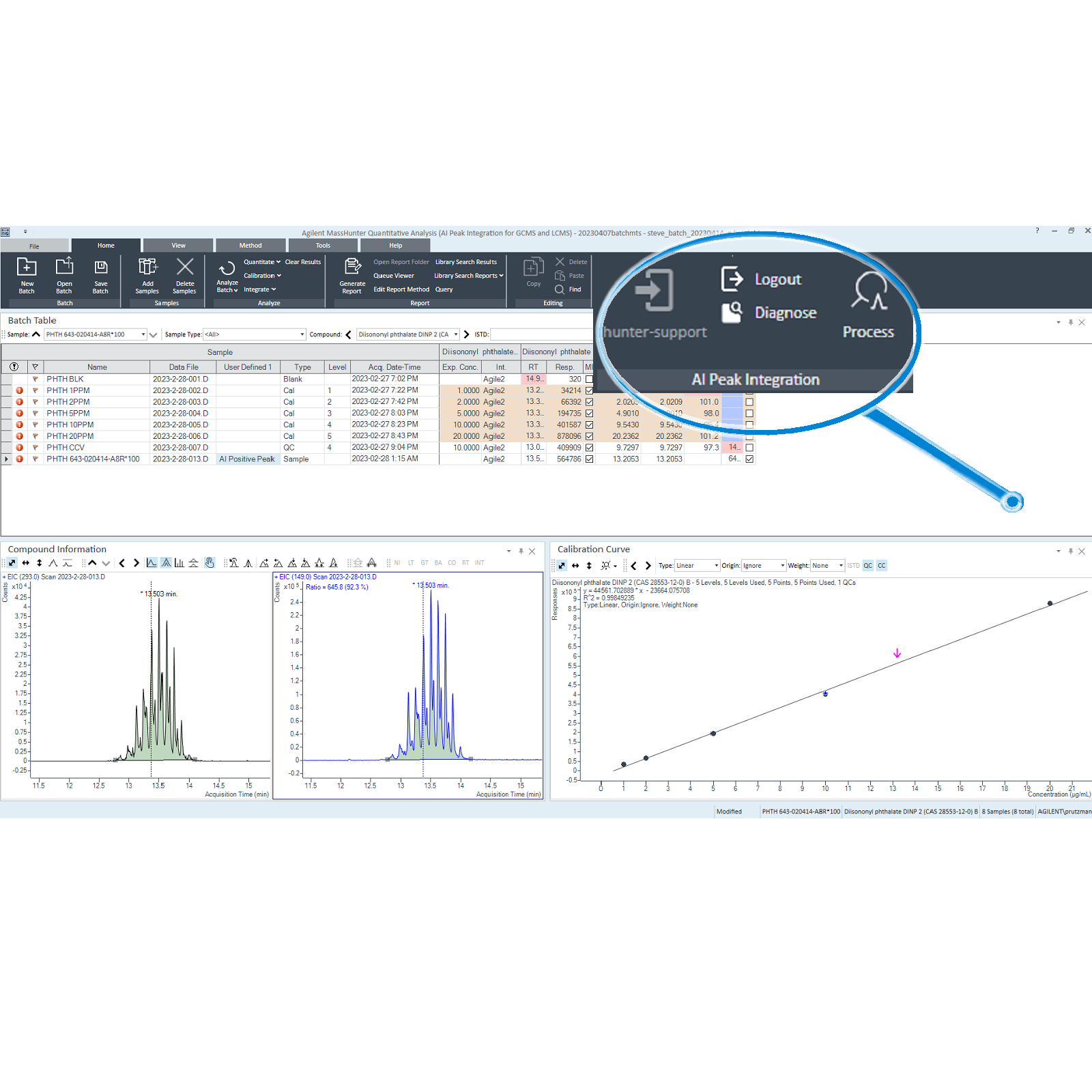
- Agilent AI Peak Integration for MassHunter software automates manual peak detection and integration during the data analysis process for phthalates and TDCPP when using single quadrupole GC/MS. A machine learning model is custom trained during a user’s normal data analysis workflow by observing manual integration events. It then replaces manual peak integration with adaptive AI-assisted peak detection and integration.
- AI Peak Integration software continuously learns from your data in the background and copies your manual analysis methods, making it a custom fit for your lab. It maximizes sample throughput and produces consistent analytical results across multiple users and multiple labs or locations. This next level of process automation shortens quantitative analysis time, minimizes the need for manual reintegration, and is easy to use—dramatically improving overall lab efficiency.
- <i>Currently only available/supported in the US and selected countries in Europe (Austria, Belgium, Denmark, Finland, France, Germany, Ireland, Italy, Netherlands, Sweden, Spain, Switzerland, and UK).</i>
- Automated peak integration for GC/MS analysis of phthalates and TDCPP, which are notoriously difficult to integrate during the data analysis process
- Reduced manual review and integration efforts by up to 75% via adaptive AI-assisted peak detection/integration that exhibits continuous learning
- Improved peak detection accuracy with every sample submission as the AI algorithm/machine learning model constantly learns
- Consistent results achieved using the same trained machine learning model, allowing sample data to be reanalyzed and re-evaluated anytime, simplifying audit verification needs
- Custom-trained models, created and taught by the user, adapt to their unique lab peak detection protocols and patterns
- Support for more than one trained machine learning model for phthalates or TDCPP per user or laboratory site, allowing AI peak integration algorithms for different analysis purposes or methods
- Version-controlled trained machine learning models allow you to go back to saved model versions or change them over time
- Cloud-based solution allows for scalable deployment of the peak finding software and easy, flexible update of features
Overview
Specifications
How it works
Improved GC/MS peak integration for phthalates via AI/machine learning (ML) modeling
Phthalates used in consumer products are challenging for GC/MS peak detection/integration even with automated tools, needing expert manual integration during data analysis. AI Peak Integration software operates first in passive mode, building an ML model based on a chemist’s analysis workflow. Data analysis is continuously monitored and fed into a training pipeline to generate a model using a deep learning neural network. Once certain thresholds are met, the model can be used, drastically reducing the need for manual integration corrections.


AI peak integration improves data analysis workflow and productivity
Once an ML model has been created, AI Peak Integration for MassHunter cuts analysis time down to minutes, allowing chemists to spend time on other tasks. AI processing replaces manual processing in your normal data analysis workflow, reducing repetitive and tedious effort on the data analyst.
Benefits of AI peak integration include:
- Reproducible results
- Reduced turnaround time
- Universal consistency of analytical results
- Ease-of-use for expert and new lab analysts
- Improved overall lab efficiency
Frequently asked questions
AI Peak Integration for MassHunter FAQs
Get answers to commonly asked questions about AI Peak Integration for MassHunter.
style
News
Agilent Intelligent Mass Spectrometry Solutions to Inspire at ASMS 2023
Agilent announced new mass spectrometry solutions, including AI Peak Integration Software for MassHunter Quant which replaces manual peak integration with adaptable AI-assisted peak detection & integration for analytical test labs using single quadrupole GC/MS, MassHunter BioConfirm 12.1 Software, and the 1260 Infinity II Hybrid Multisampler
06 Jun 2023
Related products
PRDT_2539444
PRDT_894000