Agilent Clarity Software
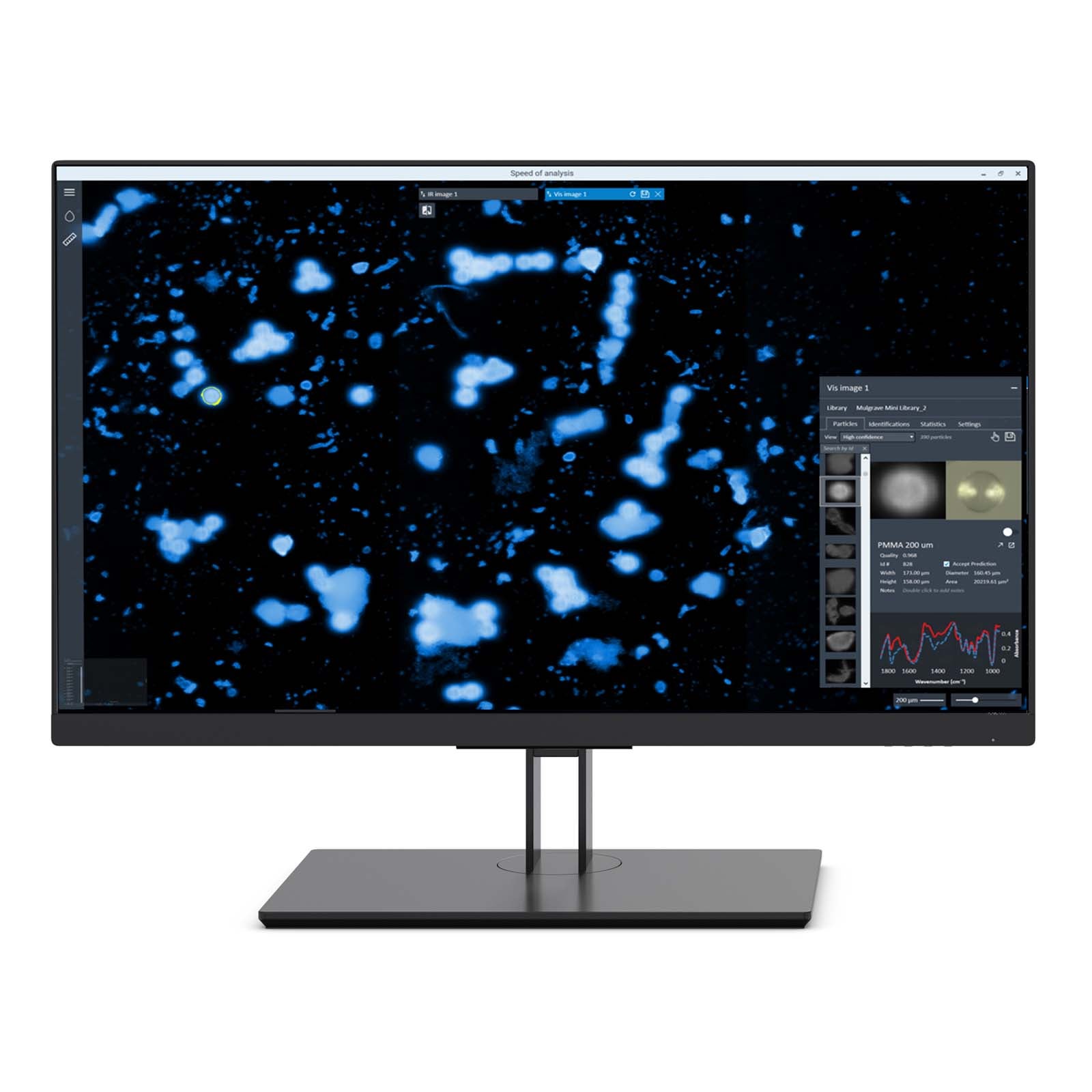
Automate particle identification and classification
- Agilent Clarity software facilitates complex data interrogation and reporting. This intuitive visualization software delivers ease and simplicity with a redefined chemical imaging data experience. Users are now able to combine high spatial resolution compositional analysis with spectral library matching.
- Fast, easy method creation
- Spectral analysis including mathematical functions (e.g., variance, addition, averaging) and spectrum transformations
- Create and search libraries for fast and reliable compound identification
Overview
Technology
The Best Technologies for Microplastics Analysis
Comparing laser direct infrared (LDIR) imaging, GC/MS, FTIR, and Raman imaging as technologies for the analysis of microplastics in the environment and food chains.
Agilent Molecular Spectroscopy Software Support Lifecycle Policy
Check the lifecycle status for revisions of the Agilent molecular spectroscopy suite of software products, so you can plan and maintain an active support status.
supplemental-information
News
New Agilent Community Spectroscopy User Groups for TRS100 and 8700 LDIR
The Agilent Community, an online customer support and forum space, has expanded to include two specialized user groups focusing on transmission Raman spectroscopy and the 8700 LDIR for microplastics analysis. These groups allow for dedicated spaces for conversations and knowledge sharing.
11 Sep 2023
Webinar: Challenges in Microplastics Analysis—From Routine Laboratory Testing to Pushing the Boundary on Particle Sizes
There are many challenges in the fast-developing field of microplastic analysis. In this webinar, we will hear from two speakers addressing quite different challenges, but nonetheless, challenges faced by many. The first speaker, Dr Gbotemi Adediran from the UK Centre for Ecology and Hydrology, will explore the opportunities and challenges in analyzing sub-micron-sized (< 5µm) microplastics analysis by LDIR. In the second presentation, Dr Julia Jaeger from Eurofins Environmental Testing—Australia & New Zealand will explore advancements and challenges related to the application of LDIR for routine microplastic analysis.
06 Sep 2023
LDIR Enables Accurate Microplastic Characterization in Infant Formula
Reports of the omnipresence of microplastics have mainly focused on their presence in the environment, but there is a growing interest in investigating the health impacts of microplastics. Many people would assume that infants' exposure to microplastics would be limited. However, infant formula was found to be a possible exposure pathway. In a recent application note, the 8700 LDIR Chemical Imaging System was used to accurately identify and quantify microplastics in infant formula. The study also shows the importance of quality control in microplastics analysis. Read the application note.
01 Jun 2023
Training & events
Microplastics Analysis Doesn't Need to Be So Hard
Watch this webinar to discover how LDIR offers a rapid, easy and effective technique for identifying and characterising microplastics in various water samples.
Molecular Spectroscopy Webinar Curriculum
Molecular Spectroscopy Webinar Curriculum includes UV-Vis, UV-Vis-NIR, fluorescence, handheld and benchtop FTIR, and Raman systems for high performance and flexibility
Related products
Need help? Contact our support team
If you didn't find what you need, try these resources or contact a specialist

Get support from our technical experts driving lab performance and reliability
World-class team of experts dedicated to you. Hand-selected from across the globe, each bringing a wealth of experience and expertise to help you solve your issue quickly and efficiently.

Submit a question
Contact our team of spectroscopy experts.
Software downloads
Manage and effectively operate your software licenses with SubscribeNet.
Software support lifecycle policy
Check the lifecycle status for revisions of the Agilent molecular spectroscopy suite of software products.
Contact support
Connect with your local Agilent team.